A Telegram From Sarah Childress
At 11 a.m. on Thursday 18 September 1873, a clerk at the Philadelphia banking house of Jay Cooke & Co handed his employer a telegram from the firm's New York office. Stocks were sliding. Drexel, Morgan & Co had refused to take any more Northern Pacific paper as collateral. Cooke's eldest partner had already locked the door of the New York office on Nassau Street to keep depositors from rushing the counter. Jay Cooke, the man who five years earlier had been hailed as the "financier of the Civil War" — the banker whose travelling salesmen had placed more than $400 million of US Treasury 5-20 bonds in the pockets of Union households — read the cable, walked to the door of his Philadelphia office at the corner of Third and Chestnut, and ordered the doors closed. By noon Jay Cooke & Co had suspended payments. Within thirty minutes the news ran the length of Wall Street and the New York Stock Exchange dissolved into what one floor witness called "a roar like the crash of a falling building."
Two days later, on the morning of Saturday 20 September, the governing committee of the New York Stock Exchange voted to suspend trading. The exchange did not reopen until Tuesday 30 September. Ten calendar days. The closure was the longest scheduled shutdown in the exchange's history before the First World War (Mixon, 2008). When trading resumed, the panic had already mutated into a banking crisis, and the banking crisis was about to harden into a depression that would last, by the National Bureau of Economic Research's reckoning, until March 1879 — sixty-five months, the longest contraction in American history until the 1930s (Rezneck, 1950).
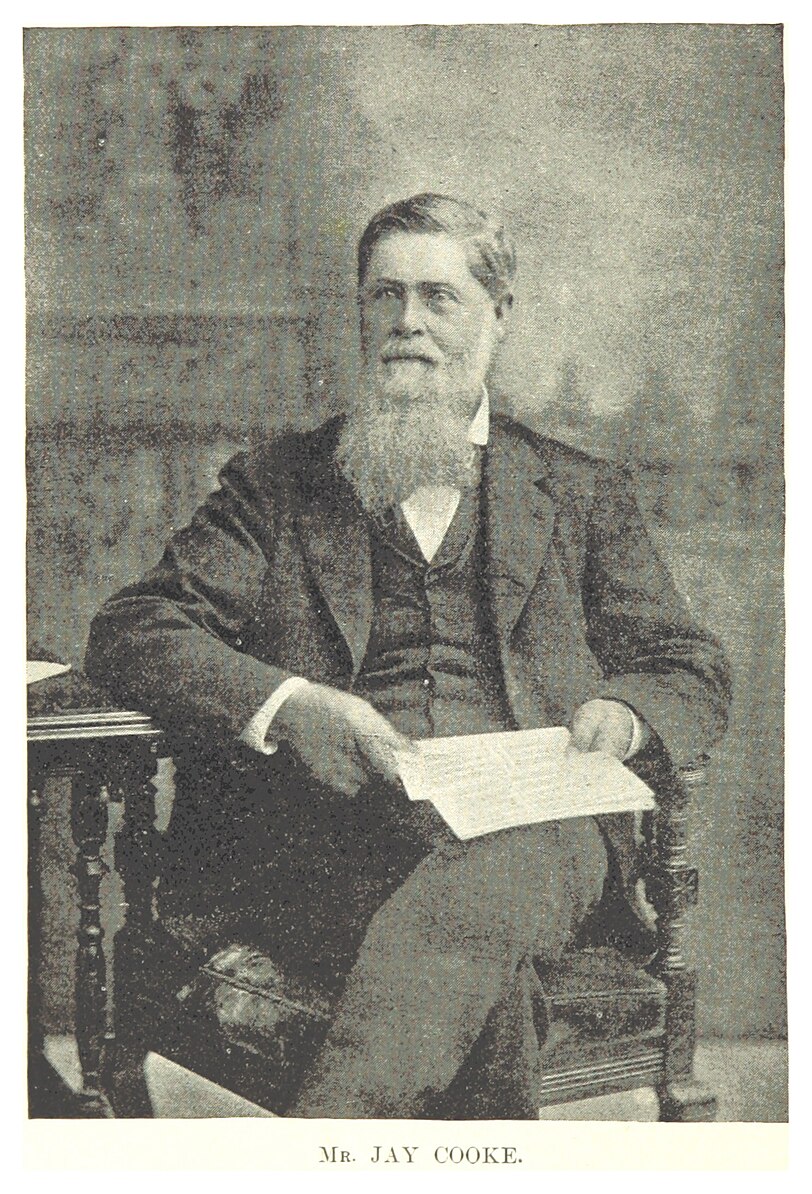
The Banker Who Sold the War
To understand why a single Philadelphia partnership could trigger a continental panic, you have to start with the bond drives of 1862-1865. When Treasury Secretary Salmon Chase needed to sell hundreds of millions of dollars of Union 5-20s in a country with no real retail bond market, he hired Cooke as fiscal agent on a quarter-percent commission. Cooke recruited 2,500 sub-agents, took out advertisements in country newspapers, and persuaded households across the Northern states to buy government paper in $50 and $100 denominations. By 1865 he had distributed close to $1.6 billion in Union securities to roughly one million subscribers — the first true mass bond market in any country. The reputation he earned in those years was the entire collateral on which his postwar career rested.
When the war ended Cooke turned the same machinery to private railway finance. In 1869 his firm signed a contract with the Northern Pacific Railway Company to underwrite the construction of a 2,000-mile line from Duluth on Lake Superior to Puget Sound on the Pacific coast — a route through territory that, in 1869, contained no significant towns west of Minnesota. The federal land grant attached to the line was 47 million acres, an area roughly the size of New England. Cooke proposed to fund construction by selling $100 million of Northern Pacific 7.30 percent gold bonds — the "Seven-Thirties" — to the same households who had bought the Union 5-20s, and to the German and Dutch savers who had taken Civil War paper at par.
He was not selling a railroad. He was selling, as his prospectuses put it, "the empire of the Northwest" — wheat lands, timber, copper, and the prospect of an American transit route to the Asia trade. Most of the towns the line would eventually serve had not yet been platted.
The Postwar Construction Surge
Between 1867 and 1873 American track mileage rose from roughly 39,000 to 74,000 — a near doubling in six years. The peak years were 1871 and 1872, when more than 7,300 miles were laid annually, a construction rate not exceeded in the United States until the 1880s. Most of that mileage was financed by bonds sold abroad. By 1873 European investors held an estimated $1.5 billion of American railway paper, with German and Dutch holdings concentrated in the new transcontinental routes (Nelson, 1986).
Source: Poor's Manual of Railroads (1881); Historical Statistics of the United States, Series Q-321
The chart shows the precise pro-cyclical pattern that recurs through every later infrastructure mania — Florida land in 1925, the utility holding companies of the late 1920s, the fibre-optic build-out of the late 1990s, and the housing surge of 2003-2006. Construction peaks just before credit tightens, then collapses to a fraction of its peak rate within twenty-four months. The four years from 1874 through 1877 averaged roughly 2,200 miles laid per year, less than a third of the 1871 peak.
The capital that financed the boom did not arrive evenly. Between 1869 and 1872 European savers — chiefly in Germany, the Netherlands, and Britain — bought American railway bonds at unprecedented volumes. Two interlocking events ended that flow. First, the Franco-Prussian war indemnity: under the Treaty of Frankfurt in May 1871 France agreed to pay Germany 5 billion gold francs, the largest cash transfer in European history to that point. The transfer ran from 1871 to 1873 and absorbed the bulk of German savings into French bills and German government paper. Second, the speculative boom in Vienna and Berlin that the indemnity gold helped finance — the Gründerzeit boom — peaked and broke on 9 May 1873, when the Vienna bourse crashed. By June, German banks were calling loans home and refusing fresh American railway commitments.
The Cooke firm spent the summer of 1873 trying to push the second tranche of Northern Pacific Sevens out the door. Cooke himself wrote optimistic public letters about the impending arrival of European subscriptions that did not arrive. By August his Philadelphia house was lending the railroad against unsold bonds at par to keep the construction crews paid. By early September the firm was funding those loans with overnight call money borrowed in New York. When the New York Warehouse and Security Company failed on 8 September on bad railroad collateral, then Kenyon, Cox & Co failed on 13 September on Canadian railway paper, depositors began pulling cash from every house known to be in the railroad bond business. Cooke went last because he was largest.
The Coinage Act and the Money Supply
A second piece of legislation pulled in the opposite direction from the bond market. On 12 February 1873 Congress passed the Coinage Act, an obscure-looking statute that ended the free coinage of silver and put the United States on a de facto gold standard. The bill had been drafted by Treasury bureaucrats, not by Congress, and most members did not understand its implications when they voted. Western silver miners and grain-belt farmers, when they noticed the change a year later, called it the Crime of '73.
The mechanics were simple. Before the Act, anyone could bring silver bullion to the US Mint and have it struck into legal tender silver dollars at the statutory ratio of 16 ounces of silver to 1 ounce of gold. After the Act, only gold could be coined freely. As world silver production rose through the 1870s, the disconnect between the silver miners' product and the country's monetary base became the great political grievance of the prairie. The contraction of currency in circulation that followed — from a wartime peak of about $30 per capita in 1865 to roughly $19 in 1879 — meant that every fixed-rate farm mortgage incurred during the boom became progressively heavier in real terms. Deflation across 1873-1879 averaged roughly minus 3.5 percent per year measured by wholesale prices. Farmers who had borrowed at 8 percent in 1872 to plant Iowa corn or Kansas wheat were paying back, in real terms, more than 11 percent — and in many counties their cash receipts had halved.
After the Closure
When the New York Stock Exchange reopened on 30 September the immediate panic was past, but the credit machinery on which the country's industry depended had broken. Through October and November 1873 bank runs spread from New York to Philadelphia and Pittsburgh. By the end of the first year, 57 of the 364 national banks had suspended or failed, alongside dozens of state and private institutions (Sprague, 1910). The next two years took out a comparable number again.
| Major railroad receiverships, 1873–1876 | Date | Cause |
|---|---|---|
| Northern Pacific Railway | June 1875 | Default on Cooke-syndicated bonds; reorganised under Frederick Billings 1879 |
| Atlantic & Great Western | January 1874 | Unable to pay coupon on London-held bonds |
| Texas Pacific | December 1875 | Could not place new construction bonds in Europe |
| Erie Railway | March 1875 | Inherited Drew-Gould-Fisk debt; English bondholder revolt |
| Wabash, St Louis & Pacific | 1875 | Branch overbuilding; bondholder committee |
| Chesapeake & Ohio | 1873 (December) | Construction creditors unpaid; Huntington reorganisation |
Industrial activity contracted in step. By the depression's trough in 1876 the unemployment rate stood at roughly 14 percent, with non-farm joblessness substantially higher in the eastern manufacturing states (Lebergott, 1957). Pig-iron output fell 27 percent between 1873 and 1876. New York City's relief commissioners reported some 90,000 unemployed men in the winter of 1873-1874, of whom several thousand demonstrated in Tompkins Square on 13 January 1874 and were dispersed by mounted police. The Tompkins Square clubbing radicalised a generation of urban labour and fed directly into the great railroad strikes of July 1877, the first nationwide industrial walkout in American history.
International transmission ran through the same bond markets that had financed the boom. London accepting houses with American railway exposure cut credit. Vienna and Berlin already had their own crises. The downturn that the British economist Alfred Marshall would later label the Great Depression of the late nineteenth century — and that Anglo-American historians now call the Long Depression — deepened into the late 1870s as German agricultural prices fell and English iron and shipbuilding contracted. The fuller treatment of that international story is in our companion piece on the Long Depression and the reshaping of industrial capitalism.
The Politics of the Greenback
The political response did not arrive overnight. Through 1874 and 1875 farmers and labour organisations built a third party around a single demand: stop retiring the Civil War greenbacks. The greenbacks were unbacked Treasury notes issued in 1862 to fund the war, of which roughly $356 million remained in circulation in 1873. The Resumption Act of January 1875, signed by Ulysses Grant, committed the Treasury to redeeming the greenbacks in gold beginning 1 January 1879 — a contractionary measure deeply unpopular in the West. The Greenback Party, formally organised in November 1874, polled 81,000 votes in the 1876 presidential election and more than a million in the 1878 midterms, sending fourteen members to the 45th Congress.
Two pieces of legislation followed. The Bland-Allison Act of 1878, passed over Rutherford Hayes's veto, required the Treasury to buy between $2 million and $4 million of silver each month and coin it as standard dollars — the first re-monetisation of silver after the Crime of '73. The Resumption Act took effect on schedule on 1 January 1879, putting the dollar back on the gold standard at the prewar parity. The political coalition that those two laws split — gold-standard easterners versus silver-and-greenback westerners — would dominate American politics for the next twenty years and reach its peak in William Jennings Bryan's "Cross of Gold" speech at the 1896 Democratic convention. The 1893 sequel to the 1873 panic — when silver, railroads, and bank runs combined again — is treated in the Panic of 1893 and the silver-railroad collision.
The agrarian movement that grew alongside the Greenback Party was the National Grange, also known as the Patrons of Husbandry. The Grange had been founded in 1867 as a fraternal organisation, but the depression turned it into a political force. By 1875 it had 858,000 members and had pushed Granger Laws through the legislatures of Illinois, Iowa, Wisconsin, and Minnesota. The Granger Laws regulated railroad freight rates and grain elevator charges, and they survived a Supreme Court challenge in Munn v. Illinois (1877), which established the principle that businesses "affected with a public interest" could be subject to state rate regulation. That doctrine became the constitutional foundation for the Interstate Commerce Act of 1887 and, through it, the entire structure of American utility and transport regulation that endured until the deregulation wave of the late 1970s.
What the Panic Taught and What It Did Not
A century later the financial historian Aldo Musacchio observed that the 1873 panic remained the textbook example of how pro-cyclical credit to a single infrastructure sector — financed by foreign portfolio capital and a domestic underwriter with reputational rather than capital backing — propagates into a sustained depression (Musacchio, 2010). The pattern was not new in 1873; the British railway mania of the 1840s had run to almost exactly the same rhythm, treated in the Railway Mania and Britain's Victorian tech bubble. The pattern was not retired in 1873 either. The same mechanics drove the Florida land collapse of 1925, the utility-holding-company failures of 1929-1932, the telecom bond bust of 2001, and the housing-bond crisis of 2007-2008. In each case a single asset class absorbs an enormous share of investor capital on the strength of a credible growth story; a single underwriter or a small handful of underwriters become indispensable to placing the paper; an external shock interrupts the new-issue calendar; and the underwriter's inventory turns from collateral into a liability.
The 1873 panic also taught American politicians a lesson that was not the lesson Cooke himself would have wanted them to draw. Where the bond crisis of 1907 produced J.P. Morgan's organising of the bankers in his library — the prelude to the Federal Reserve, treated in our piece on the Panic of 1907 and Morgan's last rescue — the 1873 crisis produced a generation of farmers and labourers who concluded that finance capital itself, not its periodic accidents, was the enemy. The argument they made in 1876 — that the money supply was too tight, that the railroads charged too much, that gold favoured the creditor over the debtor — would be made again in 1894, in 1932, and in different language in 1976 and 2010. Earlier American panics, including the Panic of 1837 and Jackson's destruction of the Second Bank, had set the template; 1873 made it permanent.
Cooke himself recovered, after a fashion. The firm was wound up at 24 cents on the dollar to depositors. He left Philadelphia, moved west, and bought into the Horn Silver Mine in Utah in the late 1870s. By 1880 he was solvent again, and by his death in 1905 he had paid every depositor in full from his second fortune. Northern Pacific completed its transcontinental line under Henry Villard in September 1883 — ten years and one month after Cooke's failure, on land that had cost American settlers, German bondholders, and a generation of unemployed industrial workers more than any reasonable accounting could measure. The last spike was driven at Gold Creek, Montana, on the afternoon of 8 September 1883. Cooke watched from the platform.
Related
Historical records Learn more about our methodology.