The 2023 Banking Crisis: SVB, Signature, Credit Suisse in a Month
At 12:32 in the afternoon of Wednesday 8 March 2023, Silicon Valley Bank's chief executive Greg Becker pressed send on an after-hours press release announcing a $1.8 billion loss on the sale of $21 billion of available-for-sale Treasuries, paired with a plan to raise $2.25 billion of new equity to repair the hole. He then placed a video call to the bank's largest venture-capital depositors and asked them, in his words, "to stay calm." By the time the New York close arrived twenty-eight hours later, $42 billion had walked out of SVB's deposit accounts in nine business hours — about $1 million every second the bank was open. By Friday morning the California Department of Financial Protection and Innovation had pulled SVB's charter and handed the wreckage to the Federal Deposit Insurance Corporation. Two days later Signature Bank in New York was gone. Eleven days after that the Swiss government married Credit Suisse to UBS in a Sunday-night press conference at the Bundeshaus.
A bank run that takes nine hours, on a balance sheet that took thirteen years to build, is a different animal from anything in the previous century of banking history. The crisis of March 2023 was the first to be conducted entirely through mobile transfers and group chats, and it forced regulators to invent a new emergency facility before the New York open on Monday morning.
The Deposit Surge That Built the Trap
Silicon Valley Bank had ridden the venture-capital wave from its founding in Sand Hill Road in 1983 into a $200 billion balance sheet by the end of 2021. Between 2019 and 2021 deposits tripled, from roughly $60 billion to $189 billion, as record fundraising rounds parked their proceeds in operating accounts at the bank that had positioned itself as the lender of choice to early-stage technology firms. Roughly half of all US venture-backed startups banked there. By the end of 2022 about 95 percent of SVB's deposits exceeded the FDIC's $250,000 insurance limit — the highest uninsured share of any large US bank.
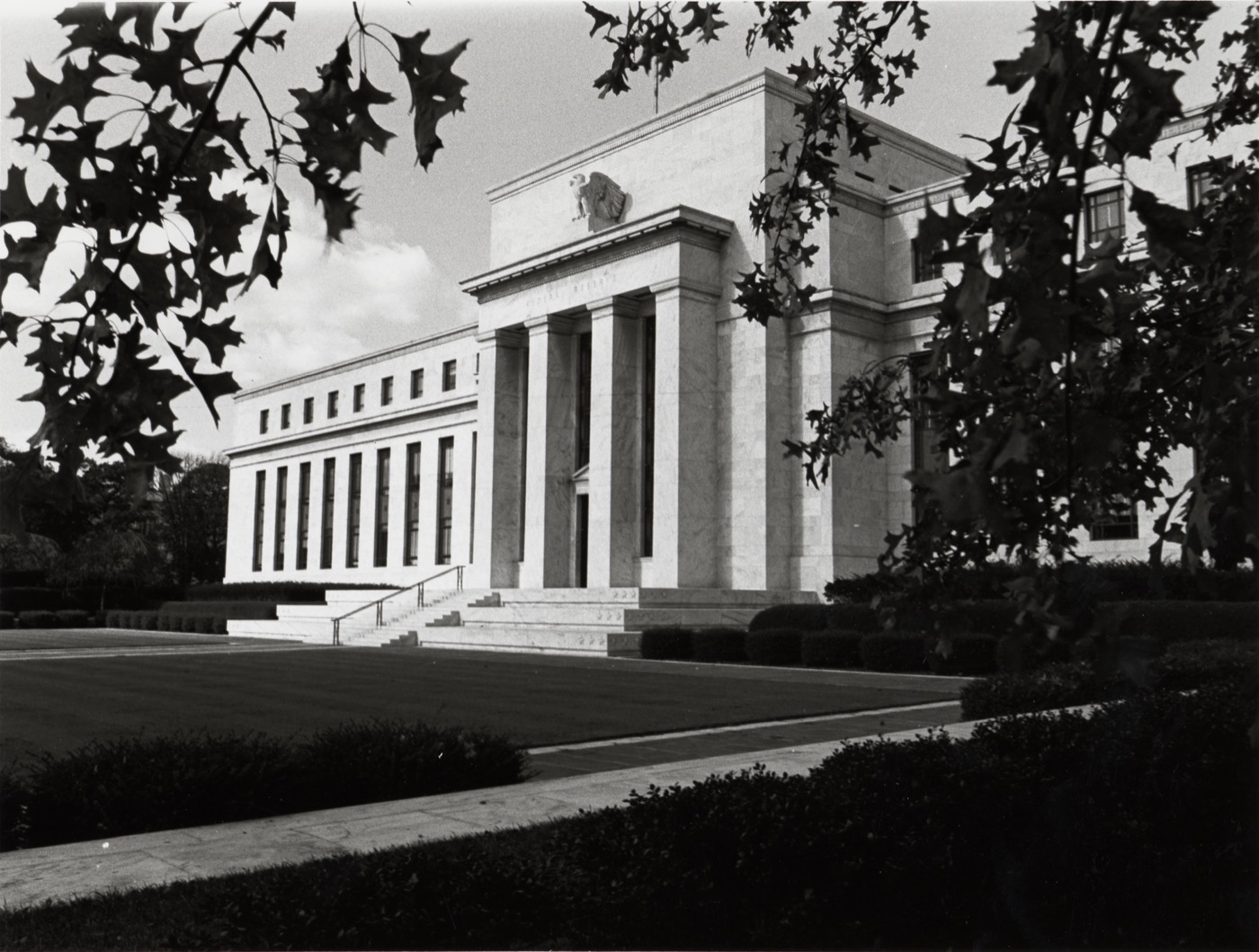
What Becker did with that flood of money is the part the post-mortems return to. Through 2020 and 2021 he authorised the bank's treasury desk to invest the deposit surge in long-duration US Treasuries and agency mortgage-backed securities, locking in yields of roughly 1.6 percent — and, critically, classifying the bulk of the portfolio as held-to-maturity (HTM). Under US GAAP, an HTM designation lets a bank carry securities at amortised cost. Mark-to-market losses do not flow through the income statement and do not depress regulatory capital, so long as the bank retains the intent and ability to hold the bonds until they pay off at par.
The Federal Reserve began lifting the federal funds rate from 0.25 percent in March 2022 and reached 4.75 percent by February 2023 — the fastest tightening cycle since Volcker. A two-percentage-point rise in the yield on a ten-year bond bought at par takes that bond's market price down by roughly 14 percent. SVB's $91 billion HTM portfolio, by the bank's own footnote disclosure in the 2022 10-K, carried unrealised mark-to-market losses of $15.16 billion against shareholders' equity of $16.3 billion. On a fair-value basis the bank was almost insolvent, but on its reported balance sheet it was well-capitalised. The Federal Reserve's own review of the failure under Vice Chair for Supervision Michael Barr (Barr, 2023) called the gap "the most consequential supervisory failure of the post-Dodd-Frank era."
The systemic version of the same trap was bigger than SVB. Jiang and Matvos (Jiang and Matvos, 2023) ran the unrealised-loss calculation across every US bank's call report and produced a number that rang through Washington in March 2023: roughly $2.2 trillion of mark-to-market losses across the US banking system, concentrated at banks whose deposit base was uninsured and mobile. SVB simply hit the wall first.
Wednesday Press Release, Thursday Run
On the morning of Wednesday 8 March, Moody's analysts called Becker to tell him SVB faced a multi-notch downgrade. He decided to pre-empt by raising equity. Goldman Sachs structured a $1.75 billion common offering and a $500 million preferred placement, anchored by General Atlantic. The mechanism for funding the equity raise required SVB to sell its available-for-sale book — the $21 billion that had not been classified as HTM — and book the embedded loss. The press release went out after hours and the share price opened Thursday at $176, down 60 percent from the previous close of $267.
What Becker did not anticipate was the speed of the deposit response. By the late afternoon of Wednesday 8 March, partner emails from Founders Fund, Coatue, Union Square, and Y Combinator had begun circulating with one-line instructions to portfolio companies: pull funds from SVB by Thursday morning. The instructions traveled through Slack channels, WhatsApp groups, and Twitter direct messages. Becker's video call on Thursday morning, intended to reassure investors, did the opposite: viewers heard hesitation and began posting timestamps to Signal groups within minutes.
| Date (2023) | Event | Magnitude |
|---|---|---|
| Wed 8 Mar | SVB announces $1.8bn loss + $2.25bn equity raise | After-hours press release |
| Thu 9 Mar | Deposit outflows accelerate via mobile and VC group chats | $42bn walks out in nine hours |
| Fri 10 Mar | DFPI seizes SVB; FDIC appointed receiver | Second-largest US bank failure |
| Sun 12 Mar | Treasury / Fed / FDIC joint statement; BTFP launched | Signature Bank seized; all depositors made whole |
| Wed 15 Mar | Saudi National Bank chairman: "absolutely not" | Credit Suisse stock falls 24 percent |
| Thu 16 Mar | Eleven banks deposit $30bn into First Republic | First Republic shares −33 percent that week |
| Sun 19 Mar | UBS forced to acquire Credit Suisse for CHF 0.76/share | CHF 16bn AT1 wiped out; CHF 250bn liquidity |
| Mon 1 May | JPMorgan acquires First Republic from FDIC | First Republic deposits had fallen $100bn in Q1 |
By 4pm New York time on Thursday 9 March SVB had received outflow orders totalling $42 billion. The bank had attempted to fund those withdrawals by drawing $20 billion from the Federal Home Loan Bank of San Francisco that morning, but the FHLB cap and intra-day collateral checks left it short. SVB closed Thursday with negative cash balances at the Federal Reserve. On Friday morning California regulators arrived at the Sand Hill Road headquarters before the building opened, hand-delivered the takeover order, and the FDIC walked through the lobby in shifts to brief staff. The four largest US bank failures, ranked by assets at seizure, are now Washington Mutual (2008), Silicon Valley Bank (2023), Signature Bank (2023), and First Republic (2023).
The Sunday-Evening Backstop
Throughout Saturday 11 March the FDIC, Treasury, and Federal Reserve worked through what to do with $151 billion of uninsured SVB deposits — about 87 percent of the bank's funding base, including operating accounts of roughly half of all US venture-backed startups. A standard FDIC resolution would have paid only insured depositors and left uninsured creditors as receivership claimants, recovering perhaps 80 cents on the dollar over twelve months. With Monday's open approaching and roughly $1 trillion of uninsured deposits across other regional banks, the regulators chose a different path.
At 6:15pm Eastern on Sunday 12 March, Treasury Secretary Janet Yellen, Fed Chair Jerome Powell, and FDIC Chair Martin Gruenberg released a joint statement invoking the systemic-risk exception in Section 13 of the Federal Deposit Insurance Act. Every SVB depositor — insured and uninsured — would be made whole on Monday morning. The same statement seized Signature Bank in New York, which had been hit by $18.6 billion of withdrawals on Friday after its concentrated crypto-industry deposit base panicked. The statement also unveiled a Federal Reserve emergency facility, the Bank Term Funding Program, that would lend US banks up to one year against Treasury and agency MBS collateral valued at par — not market — meaning a bank could pledge a bond worth 84 cents on the dollar and borrow a full dollar against it. The BTFP, in effect, undid the rate-induced HTM hole for any bank willing to use the window.
The immediate panic abated. The deeper question, raised by Cecchetti and Schoenholtz (Cecchetti and Schoenholtz, 2023) within forty-eight hours, was whether the joint statement had effectively raised the FDIC insurance limit to infinity for any depositor at any bank deemed systemic — a moral-hazard expansion larger than anything contemplated since the global financial crisis chronicled in the 2008 collapse of the system. The Continental Illinois resolution of 1984, which first articulated the "too big to fail" doctrine in the bank that coined the phrase, had likewise begun as a temporary expedient.
Zurich Catches the Cold
Credit Suisse had been bleeding for two years before SVB failed. The Archegos family-office unwind of March 2021 cost the bank $5.5 billion. The Greensill Capital supply-chain fiasco wiped out $3 billion of customer assets. Successive restructurings under Tidjane Thiam, Thomas Gottstein, and finally Ulrich Körner had failed to staunch wealth-management outflows; CHF 110 billion had walked out of Credit Suisse in the fourth quarter of 2022 alone. The bank's CDS reached 446 basis points in early March, levels last seen on Lehman in 2008. As Metrick (Metrick, 2024) shows in the cross-bank panic literature, distressed banks of comparable size historically take six to twelve months to fail; Credit Suisse compressed the death spiral into eleven days.
The trigger inside Switzerland was a delay. On 9 March, the SEC asked Credit Suisse to revise the 2019 and 2020 cash-flow statements in its forthcoming annual report. The 2022 10-K, originally scheduled for 9 March, was delayed and finally filed on 14 March with the disclosure that PwC had identified "material weaknesses" in the bank's internal control over financial reporting. The next day, asked by Bloomberg TV whether Saudi National Bank — Credit Suisse's largest shareholder at 9.9 percent — would inject more capital, chairman Ammar Al Khudairy answered, "The answer is absolutely not, for many reasons. The simplest reason is regulatory and statutory." The clip went viral within minutes. Credit Suisse stock fell 24 percent on Wednesday 15 March, hitting CHF 1.55. The Swiss National Bank announced an overnight CHF 50 billion liquidity backstop. Deposits continued running at roughly CHF 10 billion a day.
By Saturday 18 March the Swiss Financial Market Supervisory Authority (FINMA), the SNB, and the federal Department of Finance had concluded that Credit Suisse would not survive the Monday open. UBS chairman Colm Kelleher and chief executive Ralph Hamers were summoned to Bern. UBS initially offered CHF 0.25 per share — a near-zero price for a bank carrying CHF 530 billion of assets. The negotiation continued through Sunday until a final CHF 0.76 per share was agreed, with three external supports: a CHF 100 billion liquidity line from the SNB, a federal default guarantee on a further CHF 100 billion of SNB lending, and a CHF 9 billion federal loss-coverage backstop on a defined Credit Suisse non-core portfolio. CHF 16 billion of Credit Suisse Additional Tier 1 contingent-convertible bonds were written down to zero — a write-down that ranked AT1 holders below shareholders, in defiance of the bankruptcy hierarchy that AT1 buyers thought they had bought. The decision triggered an immediate $20 billion lawsuit campaign by Quinn Emanuel and Pallas Partners on behalf of bondholders, and a near-collapse of the European AT1 market that the European Central Bank, Bank of England, and Single Resolution Board moved to calm with statements within twenty-four hours.
Silicon Valley Bank Share Price, January 2022 to March 2023
Source: Yahoo Finance, NASDAQ
The chart records what regulators saw and missed. From a peak above $700 in late 2021, SIVB tracked the rate cycle downward through 2022 — losing two-thirds of its value as the long-duration bond book it carried at amortised cost grew progressively more underwater on a market basis. The decline through 2022 was orderly. The two final candles, from $267 on Wednesday 8 March to $39.49 on Friday 10 March before trading was halted, are the imprint of the run.
First Republic and the Slow Failure
Where SVB took two days, First Republic took two months. The San Francisco bank — built on jumbo mortgage lending to wealthy coastal clients — had a similar uninsured-deposit profile, with about 68 percent of deposits above the FDIC limit and a substantial book of low-rate mortgages whose fair value had collapsed under Fed tightening. In the week after SVB's failure, First Republic lost $70 billion of deposits. On Thursday 16 March eleven of the largest US banks, organised by Jamie Dimon and Janet Yellen, deposited a combined $30 billion into First Republic in a coordinated show of confidence — JPMorgan, Bank of America, Citigroup, and Wells Fargo each contributed $5 billion. The deposits were announced as uninsured term deposits, in the hope that the gesture would stabilise the wider regional sector.
It bought time, not life. First Republic's deposits continued to drain through April. The bank's first-quarter earnings on 24 April reported a $100 billion deposit decline, and the share price fell 49 percent the next day. Over the weekend of 29–30 April the FDIC ran a forced-sale auction; JPMorgan submitted the strongest bid and acquired First Republic on Monday 1 May, with the FDIC absorbing approximately $13 billion of estimated losses. JPMorgan picked up roughly $173 billion of loans and $30 billion of securities at a discount.
What the Plumbing Showed
Three structural lessons emerged inside the post-mortems. The first concerns speed. The classic Diamond-Dybvig bank-run model assumes depositors physically queue at branches, with hours of friction between the first head and the last. SVB's run, conducted entirely through mobile banking applications and orchestrated through Slack and WhatsApp, ran ten times faster. The Northern Rock queue captured in Britain's first bank run in 150 years is now a museum piece — a 2007 vintage. By 2023 the equivalent run was a Twitter timeline.
The second concerns the asymmetry between accounting and economics. The HTM designation, introduced in FASB Statement 115 in 1993 and codified in Topic 320, was designed to spare banks from quarterly volatility on bonds they intended to hold. In a regime of historically low rates and gentle yield-curve movements, the carve-out was harmless. After 425 basis points of tightening in twelve months, the carve-out was concealing the difference between solvency and insolvency at any institution whose depositors might leave on short notice.
The third concerns concentration. SVB's deposit base was 50 percent venture-funded technology startups; Signature's was 30 percent crypto-industry firms; First Republic's was wealthy coastal mortgage borrowers. Each ran on a separate WhatsApp group, but each ran in the same week. The Iceland of the banking system that grew ten times its economy had taught the same lesson in 2008: a deposit base that shares a single business cycle is not deposits, but a margin call waiting for a trigger.
The Fed's Barr Review, published 28 April 2023, concluded that SVB's "rapid growth, concentrated business model, reliance on uninsured deposits, and unhedged interest-rate risk" had been visible to supervisors for three years before the run, and that the supervisory response had been "too slow." The Federal Reserve later proposed a long-term debt requirement for regional banks above $100 billion in assets and a phased application of unrealised-loss recognition into capital ratios. The reforms were diluted in 2024 negotiations and remained partial when this article went to press. On the night of 12 March 2023 the United States Treasury, the Federal Reserve, and the FDIC stood at a podium in Washington and told the country that no depositor would lose a dollar — a sentence that quietly extended the federal balance sheet over deposits no Congress had ever voted to insure.
Related
Historical records Learn more about our methodology.