The Miracle Economy
By the early 1980s, Japan had completed one of the most improbable economic transformations in modern history. From the ruins of wartime devastation, it had built itself into the world's second-largest economy, powered by export-driven manufacturing in automobiles, electronics, and steel. Japanese management techniques — the Toyota Production System, kaizen, just-in-time manufacturing — were studied and imitated worldwide. American executives traveled to Tokyo seeking to decode the secrets of Japanese competitiveness.
Underneath the admiration lay real substance. Japanese workers were highly educated and disciplined. Close coordination between the Ministry of International Trade and Industry (MITI), major banks, and industrial conglomerates — the keiretsu — allowed for long-term strategic planning that Western firms, beholden to quarterly earnings, struggled to replicate. Household savings rates exceeding 15 percent provided a deep pool of investable capital, while an undervalued yen gave exporters a persistent edge in global markets.
But the very success of this model created the conditions for its most spectacular failure.
The Plaza Accord and Its Consequences
An international agreement lit the fuse. By the mid-1980s, the United States was running enormous trade deficits, particularly with Japan, and American manufacturers complained bitterly that the strong dollar made their products uncompetitive. On September 22, 1985, finance ministers from five nations met at the Plaza Hotel in New York and agreed to coordinate intervention to depreciate the dollar — an event known as the Plaza Accord.
It succeeded beyond anyone's expectations. The dollar fell from 240 yen in September 1985 to 150 yen by early 1987, a 37 percent appreciation of the yen that threatened to devastate Japan's export sector. Manufacturers faced a sudden and dramatic loss of price competitiveness — a phenomenon that became known as endaka fukyo, the "strong yen recession."
Governor Satoshi Sumita's Bank of Japan responded with aggressive monetary easing. The official discount rate was cut from 5.0 percent in January 1986 to 2.5 percent by February 1987 — the lowest level in Japanese postwar history. Under the Louvre Accord of February 1987, Japan had committed to stimulating domestic demand to reduce its trade surplus, giving the BOJ political cover to hold rates at this emergency level for over two years, far longer than economic fundamentals warranted. Cheap money was flooding into the system, and it needed somewhere to go.
The Bubble Inflates
It went into stocks and real estate, with ruinous consequences.
The Nikkei 225 began its ascent from approximately 13,000 in late 1985. By the end of 1986 it had crossed 18,000; by the close of 1987, despite the global shock of Black Monday in October, it recovered far more quickly than Western markets and finished near 22,000. Through 1988 and 1989 the climb steepened relentlessly. On December 29, 1989 — the last trading day of the decade — the Nikkei 225 reached its all-time peak of 38,957.44.
At that summit, the Tokyo Stock Exchange's total market capitalization exceeded $4 trillion, representing roughly 45 percent of global equity value. Japanese stocks traded at a price-to-earnings ratio of approximately 60, compared to 15 for the S&P 500. NTT (Nippon Telegraph and Telephone), partially privatized in 1987, briefly became the most valuable company in the world with a market capitalization exceeding $300 billion — more than the entire West German stock market.
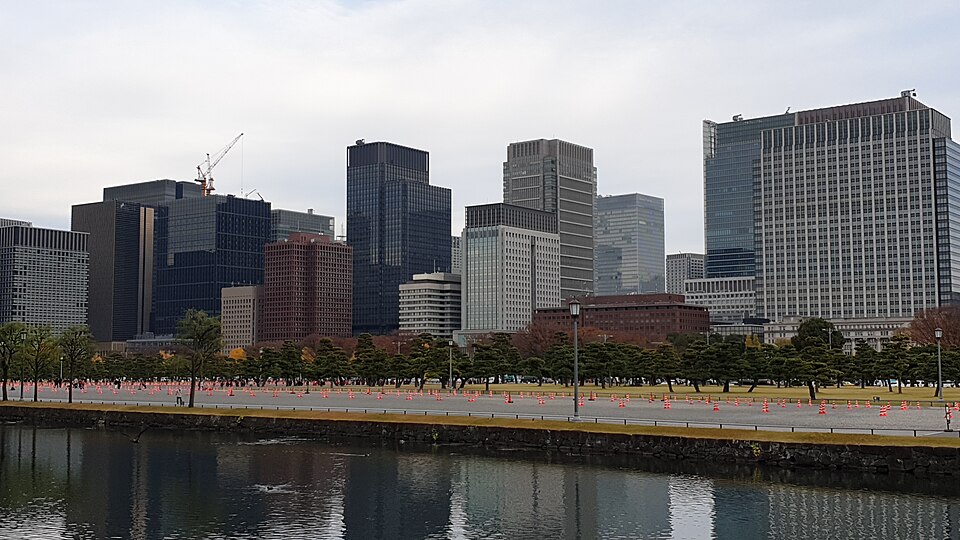
Real estate prices were more extreme still. Commercial land in Tokyo's six central wards rose 300 percent between 1985 and 1989, according to the Japan Real Estate Institute Noguchi (1994). Whether the land beneath the Imperial Palace was truly worth more than all the real estate in California may have been apocryphal, but the claim captured the absurdity of the moment. Golf club memberships — which could be bought, sold, and used as loan collateral — traded for as much as $3 million each. An actual financial instrument, the Nikkei Golf Membership Index, tracked their prices.
Source: Nikkei 225 historical data
The Psychology of Invincibility
A narrative of Japanese exceptionalism sustained the bubble. Books such as Ezra Vogel's Japan as Number One (1979) and Clyde Prestowitz's Trading Places (1988) argued that Japan's economic model was fundamentally superior to Western capitalism. Within Japan, this conviction took on an almost metaphysical quality — the phrase baburu keiki (bubble economy) would not enter common usage until after the crash. During the boom, the prevailing term was "the Heisei prosperity," suggesting not a cycle but a permanent new era.
Corporate executives embraced zaiteku — the practice of earning more from financial engineering and real estate speculation than from core business operations. Why focus on manufacturing margins when you could flip land?
Banking was central to the feedback loop. Japanese banks used their shareholdings in keiretsu partners as capital reserves, and rising stock prices automatically expanded their lending capacity. More lending pushed up real estate prices. Higher real estate prices served as collateral for further loans. Further loans funded additional stock purchases. Each asset class inflated the other in a self-reinforcing spiral that seemed to have no ceiling.
| Indicator | 1985 | 1989 (Peak) | Change |
|---|---|---|---|
| Nikkei 225 | 13,083 | 38,957 | +198% |
| Commercial Land Price Index (Tokyo) | 100 | 302 | +202% |
| BOJ Discount Rate | 5.0% | 2.5% | -250 bps |
| Bank Lending Growth (annual) | 8.2% | 12.8% | +4.6 pps |
| Yen/Dollar Rate | 240 | 143 | +40% (yen appreciation) |
| Japan GDP (trillion yen) | 330 | 421 | +28% |
| M2 Money Supply Growth | 7.8% | 11.7% | +3.9 pps |
The Ministry of Finance Tightens
In December 1989, newly appointed Bank of Japan Governor Yasushi Mieno — later described as the man who "pricked the bubble" — raised the official discount rate from 2.5 to 3.25 percent. Three more increases followed in rapid succession: 3.75 percent in March 1990, 5.25 percent in August, 6.0 percent by December. In twelve months the BOJ had more than doubled its benchmark rate.
Simultaneously, the Ministry of Finance imposed direct controls on bank lending to real estate. In March 1990, the Ministry issued administrative guidance requiring banks to limit real estate loan growth to below the rate of total loan growth — a blunt "total volume control" policy that severed the credit lifeline sustaining the property boom.
Hoshi and Kashyap (2004) argue that the policy reversal was both too late and too abrupt. The BOJ had maintained easy conditions for too long, and then tightened too aggressively, converting a potential soft landing into a crash.
The Crash
December 29, 1989, was the peak. The Nikkei never came back.
Decline began gradually in January 1990, accelerated through the spring, and turned into a rout by autumn. By October 1, the index had fallen to 20,222 — a loss of 48 percent in nine months, erasing more than $2 trillion in market value.
Real estate prices, stickier as always in illiquid markets, followed a slower but equally devastating trajectory. Commercial land in Tokyo peaked in 1991 and then fell continuously for fourteen years, declining approximately 80 percent from the summit. Residential land traced a similar path. Total destruction of real estate wealth has been estimated at over $10 trillion — roughly twice Japan's annual GDP at the time.
With the bubble's collapse, the fragility of the banking system stood exposed. Japanese banks held enormous portfolios of loans collateralized by real estate and cross-held equities, both now plunging in value. Non-performing loans — a category that banks had every incentive to conceal and regulators had little desire to acknowledge — proliferated across the system. The term "zombie banks" entered the financial lexicon to describe institutions that were technically insolvent but kept operating with implicit government support, rolling over loans to insolvent borrowers to avoid recognizing losses on their books.
The Lost Decade(s)
What followed was not the sharp recession and recovery that most post-bubble economies experience, but a prolonged stagnation that defied conventional economic remedies — a period that would become known as the "Lost Decade," though in truth it stretched to two or even three.
Cutting rates accomplished nothing. The BOJ brought the discount rate back to 0.5 percent by September 1995 and effectively to zero by 1999. Japan had fallen into what economists call a liquidity trap — a condition first theorized by John Maynard Keynes in which interest rates hit zero but investment and consumption remain depressed because households and businesses are focused on paying down debt rather than spending. Krugman (1998) diagnosed Japan's condition in a landmark paper that would prove prescient for Western economies after 2008.
Fiscal stimulus was deployed repeatedly and massively. Between 1992 and 2000, Japan enacted ten major packages totaling over 100 trillion yen, building roads, bridges, dams, and public facilities across the country. National debt rose from 60 percent of GDP in 1990 to over 100 percent by 2000 and kept climbing. Yet growth averaged barely 1 percent per year through the 1990s — down from 4 percent in the preceding decade.
Deflation compounded everything. Consumer prices, which had risen at roughly 2 percent per year during the bubble, began falling in the late 1990s and continued declining intermittently for nearly two decades. As prices fell, the real burden of debt increased, discouraging borrowing and spending in a vicious cycle. Japan became the textbook example of a deflationary trap, studied by economists worldwide — including a young Federal Reserve economist named Ben Bernanke, whose research on Japan's predicament would directly shape his response to the 2008 financial crisis.
Parallels and Lessons
Like the tulip mania of 1637 and the South Sea Bubble of 1720, Japan's bubble was fueled by a narrative of permanent transformation — the conviction that the country had discovered a superior form of capitalism. Like the dot-com bubble, it was amplified by loose monetary policy and the willingness of sophisticated institutional investors to ride speculation they knew to be unsustainable, confident they could exit in time.
What made Japan's experience distinct was where the damage concentrated. Asset bubbles that infect the banking sector are uniquely dangerous because the collapse of bank balance sheets impairs the credit channel through which monetary policy operates, rendering conventional stimulus ineffective. Japan's policy of forbearance — allowing zombie banks to continue operating rather than forcing painful restructuring — prevented the creative destruction that might have enabled faster recovery. And once deflation embedded itself in expectations and behavior, it proved nearly impossible to reverse.
Zero interest rates also spawned a global side effect. With domestic rates at zero, Japanese investors — particularly institutional ones — borrowed cheaply in yen to invest in higher-yielding foreign assets, creating a massive carry trade that would influence global capital flows for decades.
Perhaps the most sobering measure of the aftermath is the simplest one. The Nikkei 225 did not surpass its December 1989 peak until February 2024 — a recovery that took thirty-four years. For an entire generation of Japanese investors, the stock market was not a wealth-building instrument but a monument to loss. The phrase "Japan scenario" became shorthand among policymakers worldwide for the worst possible outcome of a burst asset bubble, and the determination to avoid it would shape central bank responses — from Washington to Frankfurt — for decades to come.
Related
Historical records Learn more about our methodology.