The Tulip Arrives in Europe
Sometime in the 1550s, a bulb from the Ottoman Empire made its way westward in a diplomat's luggage. Within a century, it would become the most expensive object in the world by weight — and a byword for financial folly.
Carolus Clusius, a Flemish botanist appointed prefect of the Hortus Botanicus in Leiden in 1593, cultivated the first major Dutch tulip collection from bulbs sent by Ogier Ghiselin de Busbecq, the Habsburg ambassador to Constantinople. Clusius guarded his specimens with obsessive care, but thieves raided his garden repeatedly, scattering bulbs across the provinces of Holland and Utrecht and seeding what would become an entire commercial industry. By the 1610s, growers across the Dutch Republic were experimenting with varieties, crossbreeding colors, and selling to a clientele whose appetite for novelty seemed bottomless.
Timing mattered as much as botany. When the tulip arrived, the Dutch Republic was emerging as the wealthiest commercial society in Europe. After Antwerp fell to Spanish forces in 1585, skilled merchants and artisans fled northward to Amsterdam, transforming it into the center of global trade. Disposable income was rising, cultural appetites were expanding, and the tulip — vivid, ephemeral, impossible to mass-produce — became the perfect luxury commodity for a society that prized both beauty and scarcity.
The Rise of a Luxury Market
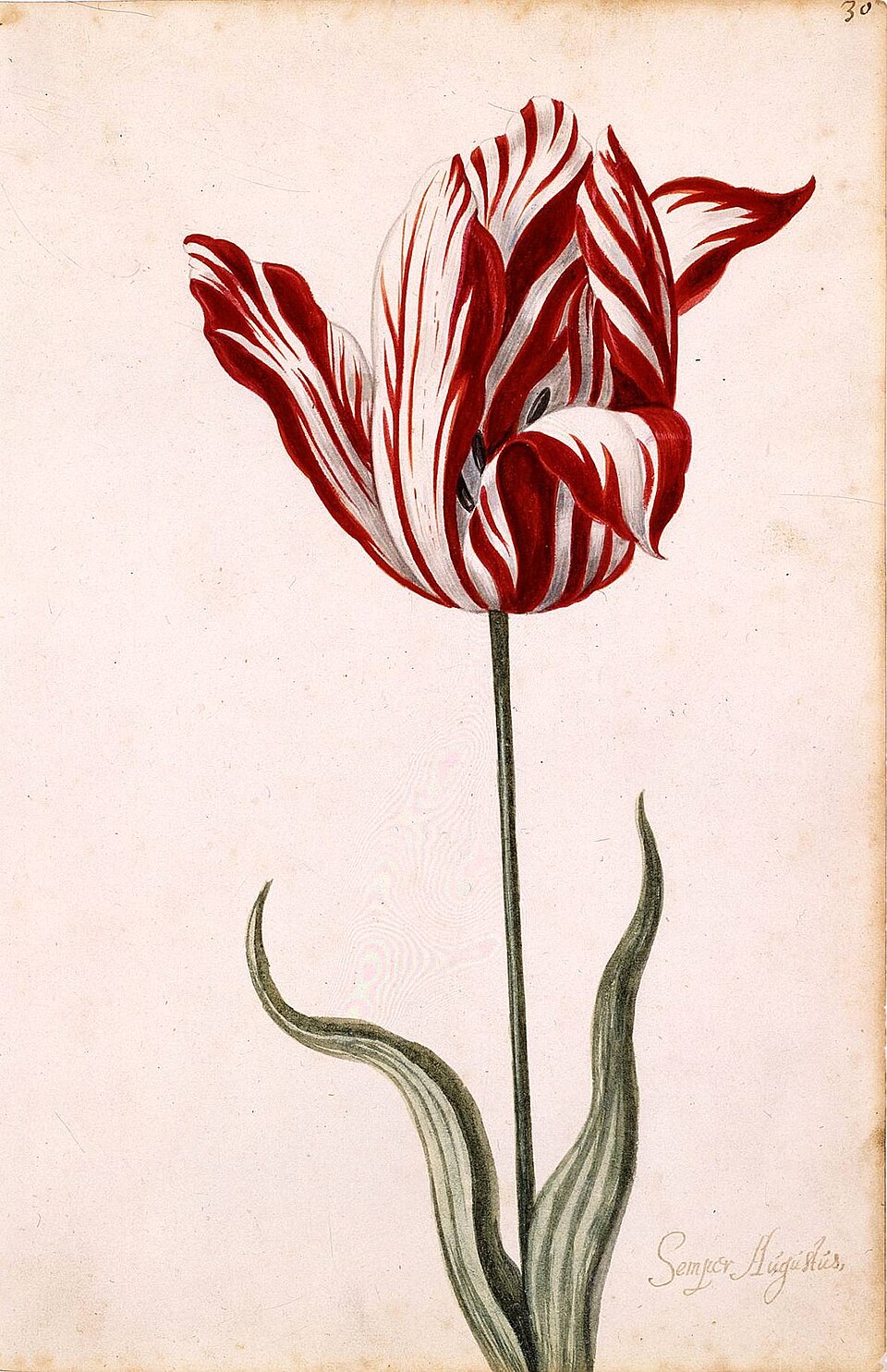
By the 1620s, tulip cultivation had evolved from horticultural curiosity into a structured market with its own taxonomy. Growers categorized bulbs by color pattern. Couleren — single-color varieties — were relatively affordable and widely available. Far more prized were the Rosen, Violetten, and Bizarden groups, whose petals displayed dramatic streaks and flames of contrasting color. What no one understood at the time was the cause: infection with the tulip breaking virus, transmitted by the peach potato aphid. Because the virus could not be deliberately introduced, broken tulips could only be propagated slowly through offsets from existing infected bulbs, making their scarcity genuine and irreducible.
At the apex of this hierarchy stood the Semper Augustus. White petals shot through with crimson streaks, it was the most celebrated bulb in the Republic. As early as 1624, a single Semper Augustus reportedly commanded 1,200 guilders — four years' wages for a skilled laborer. Only twelve bulbs were believed to exist, all held by a single Amsterdam collector who refused every offer at any price, feeding a mystique that only intensified demand.
The Speculative Frenzy of 1636-1637
Late in 1636, something shifted. What had been a market in physical goods became a speculative financial market. Traditionally, bulbs changed hands during the lifting season between June and September, when buyers could inspect what they were getting. But traders developed futures contracts — windhandel, or "wind trade" — that allowed bulbs still in the ground to be bought and sold during winter months. These contracts circulated through informal exchanges held in taverns called colleges, where deals were scratched into ledgers and sealed with small payments of "wine money."
As the windhandel spread, so did the participant base. Wealthy merchants and knowledgeable connoisseurs had dominated early tulip trading. Now weavers, carpenters, and bricklayers were crowding into the colleges, drawn by tales of neighbors who had doubled their money in weeks. Historian Anne Goldgar's research in Dutch notarial records reveals participants from a broad cross-section of urban society, though she notes the total number of active traders was probably smaller than the thousands sometimes alleged in popular accounts.
| Tulip Variety | Peak Price (Guilders) | Approximate Modern Equivalent |
|---|---|---|
| Semper Augustus | 10,000 | $750,000 |
| Viceroy | 3,000–4,200 | $225,000–315,000 |
| Admiral van Enkhuizen | 5,200 | $390,000 |
| General of Generals | 750 | $56,000 |
| Common Gouda | 60 | $4,500 |
Prices in January 1637 defied all precedent. A Witte Croonen bulb that sold for 64 guilders on January 2 changed hands for 1,668 guilders on February 5 — a twenty-six-fold increase in barely a month. One famous transaction, recorded in a pamphlet shortly after the crash, lists a Viceroy bulb exchanging for goods valued at 2,500 guilders: two lasts of wheat, four lasts of rye, four fat oxen, eight fat swine, a bed, a suit of clothes, and a silver drinking cup. At the market's peak, a collection of bulbs could fetch more than a grand canal house in Amsterdam.
The Collapse of February 1637
On February 3, 1637, buyers simply stopped showing up. At a routine bulb auction in Haarlem, not a single bid materialized. Sellers looked at one another and found no one willing to purchase at any price. Within days, the collapse in confidence raced through the trading network — Haarlem to Amsterdam, Leiden, Rotterdam, Enkhuizen — and prices that had risen twentyfold in weeks fell to a fraction of their peak values almost overnight, an early example of mean reversion in action.
Holders of futures contracts faced ruin. Buyers had committed to pay vastly inflated prices for bulbs now virtually worthless; sellers demanded payment; buyers refused. Without legal authority, the tulip colleges could not adjudicate the cascade of disputes. When the crisis escalated to municipal and provincial governments, the growers' guild in Haarlem proposed that contracts made after November 30, 1636, could be voided upon payment of a small percentage of the agreed price. But the States of Holland — the provincial legislature — declined to impose a uniform solution, leaving disputes to be resolved through local courts and private negotiation. Many contracts were simply abandoned, with neither party bothering to pursue enforcement.
Economic Impact and Modern Reassessment
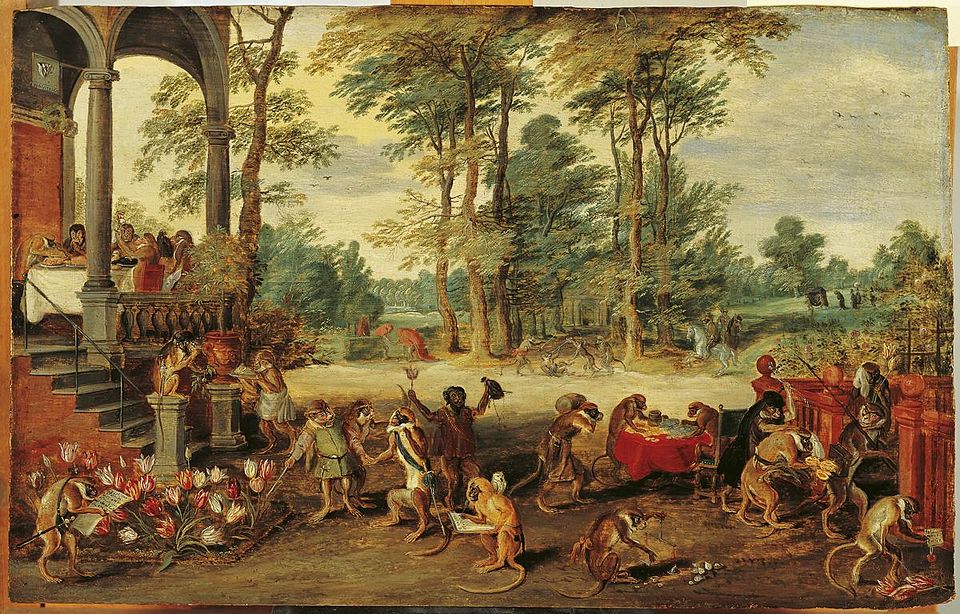
Charles Mackay bears much of the responsibility for tulip mania's outsized reputation. His 1841 book Extraordinary Popular Delusions and the Madness of Crowds portrayed the episode as a society-wide catastrophe that ruined countless families, drawing heavily on moralizing pamphlets published in the crash's aftermath — pamphlets that treated tulip speculation as divine punishment for greed.
Anne Goldgar's 2007 study Tulipmania dismantles much of this narrative. Working through Dutch notarial records, Goldgar found only 37 individuals who paid more than 300 guilders for a single bulb at the mania's height. Many transactions were futures contracts that were never settled, meaning the actual transfer of money was far smaller than the nominal prices suggest. Crucially, the broader Dutch economy — powered by the Dutch East India Company, global trade, herring fisheries, textile manufacturing — showed no measurable disruption from the tulip crash.
Economist Peter Garber pushed the revisionism further in a series of papers beginning in 1989, arguing that much of the price behavior was consistent with rational pricing of genuinely rare luxury goods. The most extreme prices, he demonstrated, were concentrated in the final weeks and involved common varieties rather than the rare broken tulips. Earl Thompson went further still in 2007, contending that a parliamentary decree had effectively converted futures contracts into options — meaning the astronomical prices reflected option premiums rather than actual expected bulb values.
The Enduring Legacy
Whether rational or mad, tulip mania established the template that financial history has repeated with eerie consistency ever since: a novel asset, rising prices, the entry of inexperienced speculators drawn by tales of easy profit — fueled by the behavioral biases that drive speculative manias — the development of leveraged instruments that amplify exposure, and the sudden collapse when confidence evaporates. From the South Sea Bubble of 1720 to the dot-com boom and the cryptocurrency surges of the 2010s, the structure recurs so faithfully it might be scripted.
Goldgar's scholarship may have reduced the economic toll, but it cannot diminish the cultural imprint. Moralizing pamphlets published after the crash became a genre unto themselves, and Dutch Golden Age painters frequently included tulips in vanitas still-life compositions — symbols of worldly vanity and the transience of earthly wealth. Four centuries later, "tulip mania" remains the first metaphor anyone reaches for when asset prices detach from reality. That a flower could carry such weight says something about the markets — and about the human appetite for a good cautionary tale.
Related
Historical records Learn more about our methodology.