The Origins of the South Sea Company
In 1711, Britain was drowning in debt. Years of war against France in the War of the Spanish Succession had swollen the national obligations to approximately 9 million pounds, and Robert Harley, Earl of Oxford and Lord Treasurer under Queen Anne, needed a creative solution. His scheme was audacious: create a joint-stock company that would absorb a portion of the government's debt in exchange for a monopoly on British trade with South America and the Pacific Islands. Holders of short-term government debt could convert their obligations into company shares paying 6 percent annual interest, guaranteed by the Crown. Parliament incorporated the South Sea Company that same year, and a financial experiment of historic proportions was underway.
From the outset, the trading monopoly at the heart of this arrangement was more fantasy than reality. Spain controlled virtually all of South America and had no intention of opening its colonial markets to British merchants. When the Treaty of Utrecht ended the war in 1713, Britain received only two concessions: the asiento — a thirty-year contract to supply up to 4,800 enslaved Africans per year to Spanish colonies — and the right to send a single trading ship annually to Spanish ports. Even this meager allowance came with strings: Spain would receive a quarter of the profits plus a tax on the remainder. Actual trading voyages generated little revenue. Whatever the South Sea Company would become, it would not become a trading powerhouse.
The Great Scheme of 1720
January 1720 marked the company's pivot from a modest debt-management vehicle into one of the most ambitious financial operations ever attempted. Sub-Governor John Blunt and his fellow directors proposed that the South Sea Company assume the entirety of Britain's outstanding national debt — approximately 31 million pounds in long-term annuities. In exchange, the company would issue new shares to annuity holders while the government paid a reduced interest rate. Profit would flow from the gap between the high price at which shares could be sold to the public and the face value of the debt absorbed.
Securing parliamentary approval required bribery on an industrial scale. Company directors distributed shares — often at below-market prices or on generous credit — to members of Parliament, courtiers, and royal favorites. The Duchess of Kendal, mistress of King George I, received a block of shares. Chancellor of the Exchequer John Aislabie championed the scheme in Parliament and later proved to have profited enormously from it. When the Bank of England submitted a competing proposal, the South Sea Company outbid it by offering the government more favorable terms. Parliament approved the scheme in April, and the machinery of speculation began to turn.
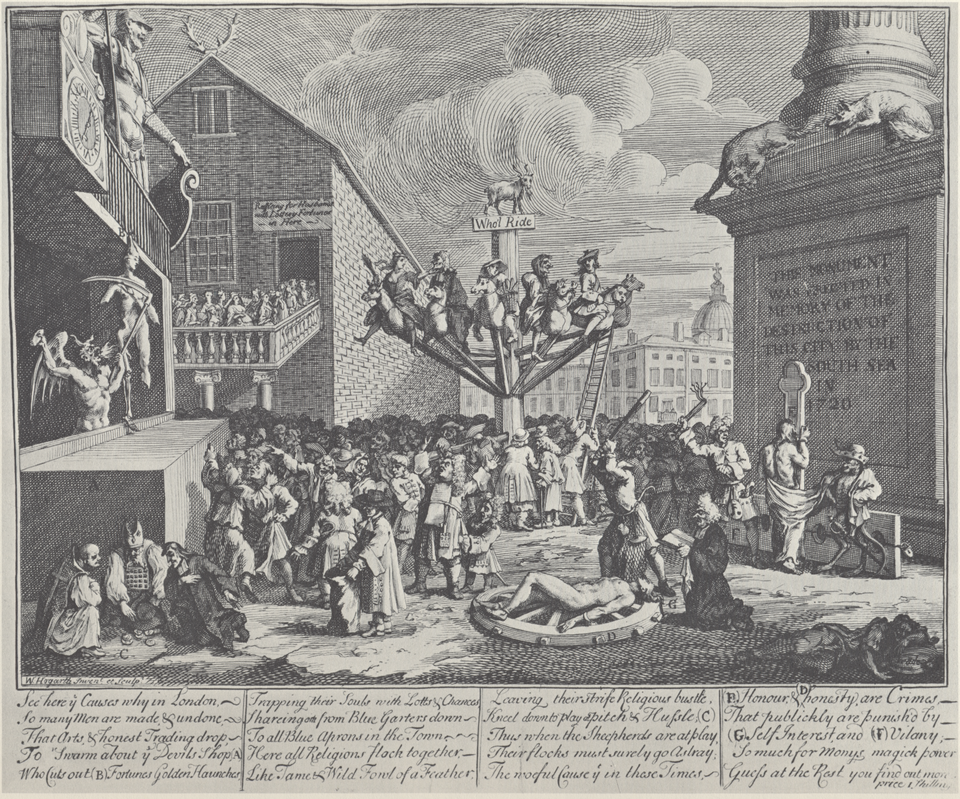
The Mania of Summer 1720
With Parliament's blessing secured, the South Sea Company launched a series of share subscriptions that sent prices into the stratosphere. Shares trading at roughly 128 pounds in January climbed to 330 by March and 550 by May. To keep the momentum alive, the company lent money to investors for the express purpose of buying its own stock — a self-reinforcing cycle of rising prices and expanding credit, amplified by favorable rumors about imminent trading profits and future dividends.
By late June, South Sea shares had reached approximately 1,050 pounds. Speculative fever spread well beyond the company itself. Scores of new joint-stock ventures sprang up to exploit the public's appetite for investment, many with wildly impractical or openly fraudulent business plans. Contemporary chroniclers described companies formed for importing jackasses from Spain, extracting silver from lead, and building hospitals for illegitimate children. One promoter famously advertised "an undertaking of great advantage, but nobody to know what it is," reportedly collected subscriptions of two pounds per share from an eager crowd, then vanished the same day.
Alarmed that these rival schemes were diverting capital from its own shares, the South Sea Company lobbied Parliament to pass the Bubble Act in June 1720. By requiring all joint-stock companies to obtain a royal charter, the Act was explicitly designed to eliminate the competition. It worked — and backfired. Shutting down rival ventures also punctured the broader atmosphere of speculative enthusiasm that had been propping up the South Sea Company's own inflated valuation.
| Date | SSC Share Price (£) | Event |
|---|---|---|
| Jan 1720 | 128 | Debt conversion scheme proposed |
| Mar 1720 | 330 | Parliament approves the scheme |
| May 1720 | 550 | Third money subscription |
| Jun 24, 1720 | 1,050 | Peak price reached |
| Aug 1720 | 800 | Bubble Act enforced; confidence cracks |
| Sep 1720 | 175 | Panic selling |
| Dec 1720 | 124 | Roughly back to starting price |
The Collapse
Late August 1720 brought the first cracks. Company insiders — including several directors — began quietly selling their own holdings. As share prices stalled, investors who had purchased on credit found themselves unable to service their loans, and confidence evaporated with a speed that stunned contemporaries. By September, shares had cratered from above 1,000 pounds to below 200. December saw them at approximately 124 pounds — roughly where they had started the year, a vivid demonstration of how prices ultimately revert to fundamentals.
Thousands of investors who had swapped reliable government annuities for South Sea shares now held nearly worthless stock. Others who had borrowed to invest at inflated prices faced crushing debts. Among the most prominent casualties was Sir Isaac Newton, the physicist and former Master of the Royal Mint. Newton had invested early in the year and sold in April at a handsome profit of approximately 7,000 pounds. But then — driven by the same overconfidence and excessive trading that afflicted so many — he reinvested a substantially larger sum near the peak. His total losses have been estimated at approximately 20,000 pounds, equivalent to several million in modern currency. "I can calculate the motions of the heavenly bodies, but not the madness of people," he is widely reported to have lamented, though historian Andrew Odlyzko has noted that the precise provenance of this quotation remains uncertain.
Political Crisis and Accountability
Public fury at the collapse threatened the stability of the Hanoverian monarchy itself. Parliament launched a formal investigation in early 1721, and the committee chaired by Thomas Brodrick uncovered corruption at every level of the scheme. Fictitious stock had been allocated to ministers, members of Parliament, and courtiers — the price of their support.
Punishment came swiftly by the standards of the era. Aislabie was expelled from Parliament and imprisoned in the Tower of London. Postmaster General James Craggs the Elder died before he could face charges; his son, Secretary of State James Craggs the Younger, died of smallpox during the investigation. Parliament arrested several company directors and confiscated the bulk of their personal estates to provide partial compensation to investors. John Blunt — the principal architect of the scheme — saw his fortune reduced from over 180,000 pounds to just 1,000.
Robert Walpole, a Whig politician who had warned against the scheme and managed to avoid catastrophic personal losses, emerged as the dominant figure in the aftermath. He orchestrated a partial rescue by arranging for the Bank of England and the East India Company to absorb a portion of the South Sea Company's shares, offering some relief to devastated investors. His handling of the crisis established his authority so firmly that he is generally recognized as Britain's first de facto Prime Minister — a position he held from 1721 to 1742.
Long-Term Consequences
For British corporate law, the South Sea Bubble cast a long shadow. The Bubble Act — originally passed to protect the South Sea Company's monopoly on speculation — remained in force for over a century, restricting the formation of joint-stock companies until its repeal in 1825. Historians including Ron Harris have argued that the Act held back British economic development by making it harder for entrepreneurs to raise capital through share offerings, though partnership structures and unincorporated associations provided alternative vehicles during the industrial revolution.
Parliamentary investigations into the scandal established early precedents for governmental oversight of financial markets. Public memory of the bubble made British investors and legislators wary of unregulated stock promotion for generations afterward. As for the South Sea Company itself, it survived in diminished form, continuing to manage a portion of the national debt until it was finally wound up in 1853 — more than 130 years after its speculative peak.
Taken alongside the roughly contemporaneous Mississippi Company bubble in France — engineered by the Scottish financier John Law — the South Sea disaster demonstrated that government-backed financial schemes could wreak havoc when combined with insider manipulation, inadequate oversight, and speculative frenzy. What makes these twin crises of 1720 endure as case studies is not their exotic historical detail but their structural familiarity: leveraged speculation, conflicts of interest between promoters and investors, and the terrifying speed with which market confidence can vanish. Three centuries on, the machinery differs. The dynamics do not.
Related
Historical records Learn more about our methodology.