The Birth of the Joint-Stock Company
On March 20, 1602, the States-General of the Netherlands granted a charter to the Vereenigde Oostindische Compagnie — the United East India Company, known universally by its Dutch initials VOC. The charter awarded the company a 21-year monopoly on Dutch trade east of the Cape of Good Hope and west of the Strait of Magellan. But it was not the monopoly itself that made the VOC historically significant. It was the financial architecture underneath.
Six existing Dutch trading companies — the voorcompagnieen — had been competing against one another in the lucrative but dangerous spice trade with the East Indies. Johan van Oldenbarnevelt, the Grand Pensionary of Holland, orchestrated their merger at the urging of the States-General, which recognized that fragmented competition was weakening Dutch commercial and military power against the Portuguese and Spanish empires. Capitalized at approximately 6.44 million guilders, the resulting entity dwarfed its nearest rival, the English East India Company, which had been founded two years earlier with just 68,373 pounds.[^1]
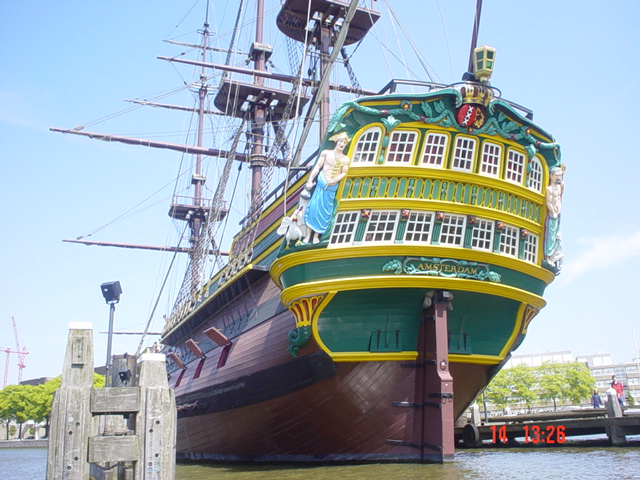
What set the VOC apart from every previous commercial enterprise was the permanence of its capital. Earlier trading ventures — including the English East India Company in its initial form — raised money on a per-voyage basis: investors contributed funds for a single expedition and received their returns when the ships came home. The VOC broke this model entirely. It issued shares in a permanent capital stock. Investors could not withdraw their money from the company; instead, they could sell their shares to other investors on the open market. This single innovation — freely transferable shares in a permanent enterprise — laid the foundation for modern capitalism.
The Amsterdam Stock Exchange
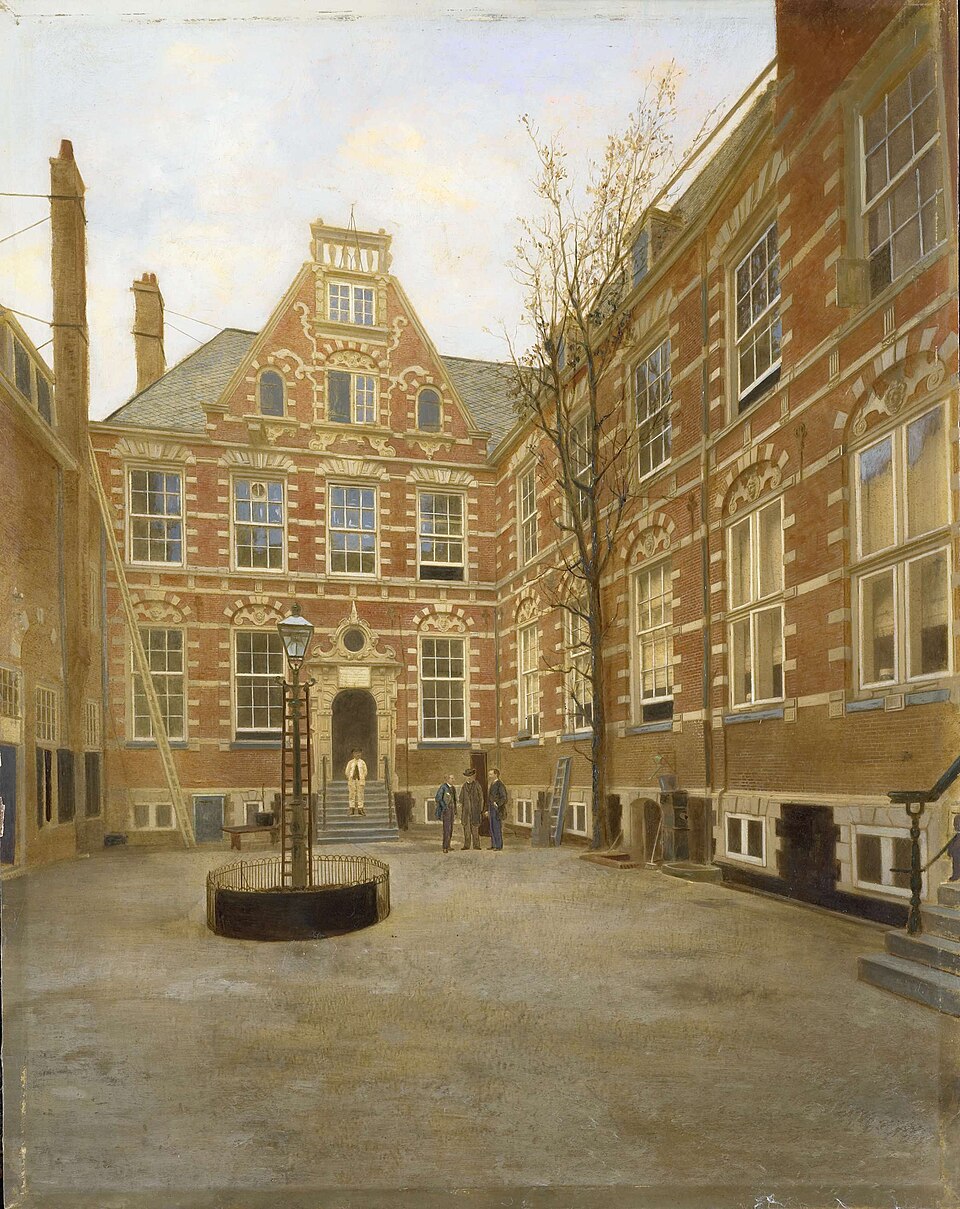
VOC shares needed a place to trade, and the Amsterdam Stock Exchange — widely regarded as the world's first formal securities market — emerged to fill that need. By 1611, a dedicated building on the Rokin canal housed regular trading sessions where VOC shares changed hands among merchants, speculators, and ordinary citizens.[^2]
Financial sophistication developed with startling speed. Forward contracts allowed traders to buy or sell VOC shares at a future date for a predetermined price. Options — both calls and puts — gave investors the right, but not the obligation, to purchase or sell shares at specified prices. Short selling, in which speculators sold borrowed shares in anticipation of a price decline, became common enough to provoke periodic government bans beginning in 1610, though enforcement proved largely ineffective.
Isaac Le Maire, a former VOC director who had fallen out with the company's leadership, organized one of history's first documented bear raids in 1609-1610. Le Maire and his associates systematically sold VOC shares short while spreading negative rumors about the company's prospects to drive the price down. The States of Holland responded with a ban on short selling in 1610 — a prohibition that, like most subsequent attempts to outlaw the practice, proved unenforceable. Joseph de la Vega's Confusion de Confusiones, published in 1688, described the Amsterdam market's practices in vivid detail and remains the oldest known book about stock trading.[^3]
None of these innovations arose in isolation. The tulip mania of 1637 unfolded in the same Dutch commercial culture that had produced the VOC and its secondary market — a culture uniquely comfortable with speculative financial instruments.
The VOC at Its Peak
By the mid-17th century, the VOC had grown into an entity without precedent. At its zenith, the company employed approximately 50,000 people worldwide, operated a fleet of nearly 200 ships, maintained a standing army of roughly 10,000 soldiers, and controlled a network of trading posts and fortified settlements stretching from the Cape of Good Hope to Japan.
Power rested on monopoly — specifically, over the spice trade in cloves, nutmeg, and mace from the Moluccas, or Spice Islands, in present-day Indonesia. The VOC enforced this monopoly with lethal efficiency. Under Governor-General Jan Pieterszoon Coen, the company depopulated the Banda Islands in 1621, killing or enslaving most of the indigenous population to secure exclusive control over nutmeg production. From its Asian headquarters at Batavia (modern Jakarta), established in 1619, the VOC administered a commercial empire that generated returns few modern investors could imagine.
Dividends — paid primarily in spices rather than cash in the early decades — averaged approximately 18 percent per year over the company's first two centuries of operation.
| Decade | Average Annual Dividend (%) | Key Development |
|---|---|---|
| 1602-1610 | 15 | Initial voyages; founding capital deployed |
| 1610-1620 | 20 | Batavia established; spice monopoly consolidated |
| 1620-1650 | 25 | Peak profitability; Banda Islands seized |
| 1650-1680 | 20 | Expansion into Ceylon (Sri Lanka), Formosa (Taiwan) |
| 1680-1720 | 15 | Coffee trade added; competition intensifying |
| 1720-1780 | 8 | Declining profits; mounting corruption |
| 1780-1799 | 0 | Fourth Anglo-Dutch War; dissolution |
Adjusted for inflation, some estimates place the VOC's peak market capitalization at approximately 78 million guilders in the 1630s-1640s, equivalent to roughly 7.9 trillion dollars in modern terms. Such cross-century comparisons are inherently imprecise, but the figure gives a sense of the enterprise's scale.
Source: Compiled from Gelderblom and Jonker (2004), Amsterdam Stock Exchange records
Financial Innovations Born from VOC Shares
More than creating a stock market, the VOC catalyzed an entire ecosystem of financial innovation. Its shares became the substrate on which modern finance was built.
Government bonds and corporate debt instruments proliferated in the Dutch Republic partly because the VOC's success demonstrated that tradable securities could function as reliable stores of value. The company itself issued bonds — obligatien — to finance operations between dividend payments, adding another layer to the securities market.
Futures contracts on VOC shares allowed merchants to hedge their exposure to price fluctuations, and these evolved into standardized instruments that bear a clear resemblance to derivatives traded on modern exchanges. Options trading emerged alongside futures. Margin trading — buying shares with borrowed money — was widespread. Repo transactions, where shares were temporarily sold with an agreement to repurchase them, provided short-term financing. Even dividend stripping — buying shares just before a payout and selling immediately after — was documented in the 1600s.
Amsterdam's 17th-century financial market was, in its essential mechanics, recognizably modern. These were precisely the kinds of instruments that would later figure in episodes like the South Sea Bubble, where joint-stock speculation spiraled out of control. The VOC's innovations eventually spread to London, Paris, and every other major financial center, forming the infrastructure of modern capital markets that would ultimately give rise to innovations like index funds centuries later.
The Governance Problem
Seeds of decline were planted in the VOC's own corporate structure. A board of 17 directors — the Heeren XVII, or Gentlemen Seventeen — drawn from the chambers of the six founding cities managed the enterprise. These directors were not elected by shareholders but appointed by city governments, creating a fundamental disconnect between ownership and control that would haunt corporate governance for centuries.
Shareholders had virtually no rights. They could not vote on company policy, inspect the books, or remove directors. The Heeren XVII published only the most rudimentary financial information, frequently delayed or misleading. In 1622, a group of disgruntled shareholders led by Isaac Le Maire petitioned the States-General for greater transparency, arguing that the directors were enriching themselves at ordinary investors' expense. The petition failed, and the VOC's governance structure remained essentially unchanged for nearly 200 years.
Without accountability, perverse incentives flourished. Company officials in Asia, operating thousands of miles from any oversight, engaged in systematic private trading — using VOC ships, warehouses, and commercial networks to conduct personal business on the side. This corruption, known as the lekkage (leakage), drained profits and became increasingly difficult to contain as the company's operations expanded.
The Long Decline
Across the 18th century, the VOC declined not in a sudden crash but in a slow hemorrhage as structural problems compounded.
The spice trade itself grew less profitable. As European tastes shifted and supply routes diversified, the premium on cloves, nutmeg, and pepper eroded. The VOC expanded into textiles, tea, coffee, and sugar, but none of these trades replicated the margins of the early monopoly years.
At the same time, the English East India Company emerged as a formidable competitor. While the VOC concentrated on the Indonesian archipelago, the English company established dominance in the Indian subcontinent and gradually encroached on Dutch trading networks in Southeast Asia. The Fourth Anglo-Dutch War of 1780-1784 proved devastating — the English navy captured several VOC ships and trading posts, and the company never recovered.
Debt, meanwhile, had grown unsustainable. Military expenditures to defend far-flung territories, combined with declining trade revenues and persistent corruption, pushed the company into chronic deficit. By the 1780s, debts exceeded 100 million guilders, and the VOC depended on loans from the Dutch government to keep operating.
Revolution delivered the final blow. When French Revolutionary forces invaded the Netherlands in 1795 and established the Batavian Republic, the new government moved to nationalize the company. On December 31, 1799, the VOC's charter expired and was not renewed. Its approximately 200 million guilders in debts were assumed by the Dutch state, its colonial possessions transferred to government administration. The world's first megacorporation had ceased to exist.
The VOC's Enduring Legacy
Every publicly listed company on every stock exchange in the world is, in a structural sense, a descendant of the VOC. The joint-stock company with freely transferable shares — first implemented at scale on the Rokin canal in 1602 — became the dominant form of business organization for large enterprises worldwide. The Amsterdam Stock Exchange, born from the need to trade those shares, established the template for securities markets. The instruments developed around VOC stock — equities, bonds, futures, options, short sales — constitute the core toolkit of modern finance. And the regulatory challenges those instruments posed, from insider trading to market manipulation, also trace their origins to the VOC era.
The company's governance failures proved equally instructive. Separation of ownership and management, absence of shareholder rights, opacity of financial reporting, corruption in far-flung operations — these problems recur throughout corporate history and continue to drive debates about executive compensation, regulatory oversight, and the rights of investors today.
And then there is the darker legacy. The VOC was a colonial enterprise that employed violence, forced labor, and environmental destruction to extract wealth from Asian populations. The Banda Islands massacre of 1621, the forced cultivation systems imposed on Javanese farmers, the company's extensive involvement in the slave trade — this record cannot be separated from the financial innovations. The mechanisms the VOC created to mobilize capital and distribute risk, mechanisms that remain fundamental to global prosperity, were first deployed in the service of monopolistic extraction and colonial violence. That tension — between the productive and destructive potential of corporate power — has never been resolved.
Related
Historical records Learn more about our methodology.