The Bank of Amsterdam: How the Wisselbank Invented Modern Money (1609-1820)
On the morning of 31 January 1609, the burgomasters of Amsterdam signed an ordinance that looked, on paper, like a piece of municipal housekeeping. Merchants were fed up with the city's coinage. More than eight hundred distinct silver and gold pieces circulated in the harbour, struck across forty-eight different mints in the Dutch provinces alone, and none of them kept a steady weight. The solution the city chose was radical in its quietness. It opened a bank — the Amsterdamsche Wisselbank — inside the Town Hall on Dam Square, and decreed that every bill of exchange drawn on Amsterdam for six hundred guilders or more had to be settled not in coin, but through the bank's ledgers. That single sentence, buried in Article 16 of the founding charter, invented modern money.
Nothing about the room on the ground floor of the Stadhuis suggested world-historical ambition. A cashier sat behind a counter. A clerk kept a folio book. Depositors brought in heavy sacks of ducatoons, patagons, rijksdaalders, Spanish reales, leeuwendaalders and assorted clipped silver, and left with a credit line written in a new, uniform unit of account — the florin banco, or bank guilder. They could not withdraw that credit as coin at will; they could only transfer it by visiting the bank in person and ordering a book entry to someone else's account. The abstraction was the point. A coin could be shaved, worn, debased by a mint in Zeeland or a counterfeiter in Aachen. A ledger entry, by contrast, was a claim on a single institution against a single assayed standard, and every merchant in Europe who traded through Amsterdam now had to own some.
Coin chaos and the problem the city was trying to solve
To grasp what the Wisselbank was reacting to, stand for a moment in the Dam in 1608. The Dutch Republic had been at war with Spain for forty years. Dozens of mints — ecclesiastical, provincial, municipal, private — stamped coins of inconsistent weight and fineness. Merchants accepted a silver piece by haggling over what it should count for. The Republic's own mint commissioners complained to the States General that "money of all kinds enters the country and money of all kinds leaves it, and no man knoweth the true value of what is in his purse." Good coin, freshly struck at full weight, was hoarded or melted for export; the worn, the clipped, the underweight circulated in its place. Gresham's dynamic was ruthless.
Bills of exchange, the core of international trade, magnified the problem. A merchant in Venice who drew a bill on his Amsterdam correspondent wanted to know, to a fraction of a gram of silver, what he would be paid. The cashiers of the city — private deposit-takers who had proliferated in the 1590s — shaved that uncertainty by picking which coins to pay in. Some were themselves running on a fraction, giving bank-like deposit facilities while lending out the metal. A run on the cashiers in 1608 forced the city's hand. The ordinance of 31 January 1609 closed down the private cashiers (the ban lasted until 1621) and concentrated large-value settlement in the new public bank.
The design was austere. The bank would not lend. It would not issue notes. It would accept deposits of specified coins at rates the bank itself would publish, convert them into bank money, and transfer that bank money between accounts on the written order of the depositor. For the first seven decades of its life, the Wisselbank kept roughly one hundred percent of its liabilities in vaulted coin and bullion. A depositor who turned up with a bag of Spanish reales and walked out with a credit of a thousand florins banco could, in theory, walk back in the next day and demand the reales back. In practice almost no one did — because the credit itself had become more useful than the coin.
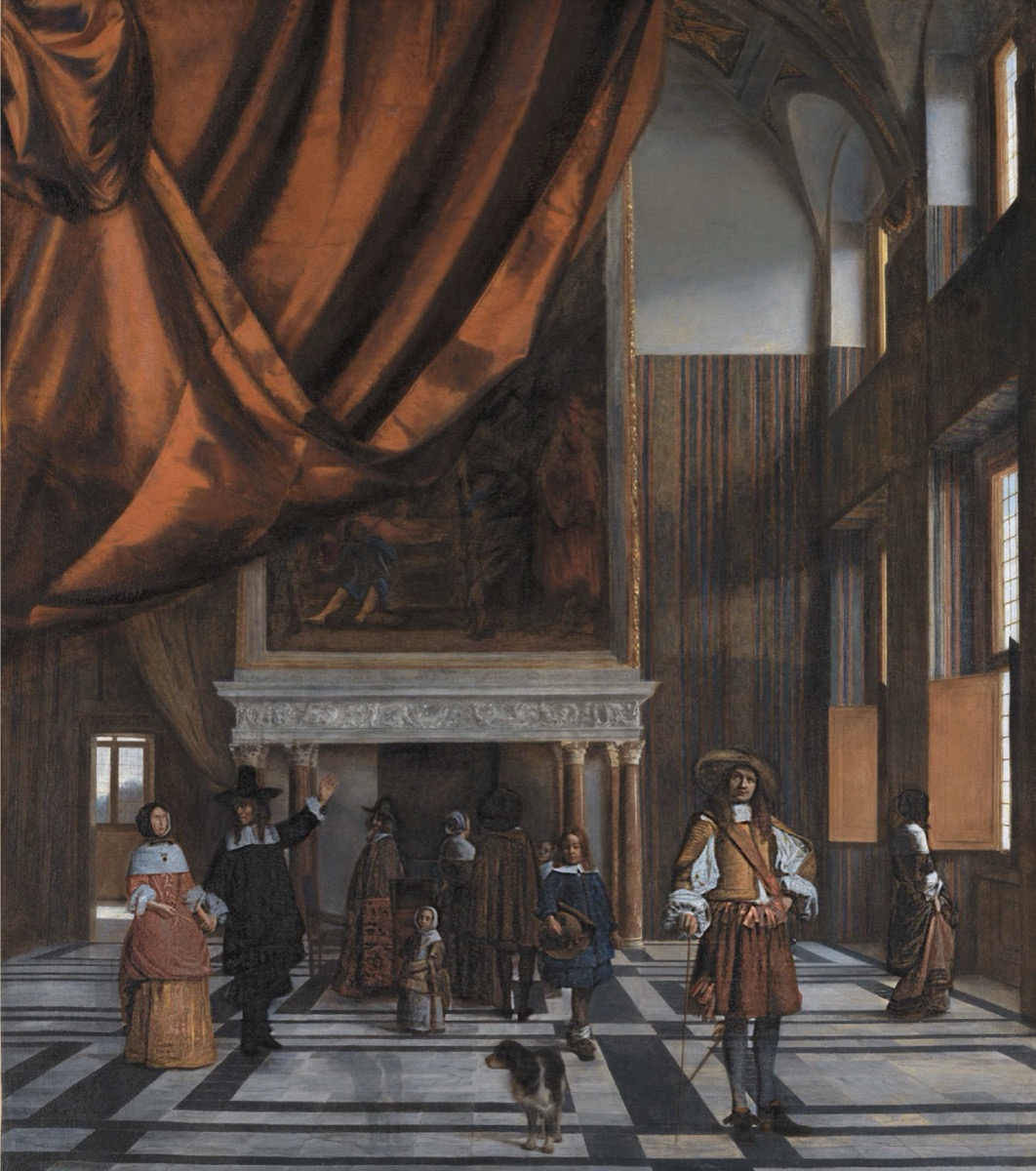
Bank money, agio, and the birth of an abstract unit of account
What made bank money useful was that it was uniform, assayed and — above all — scarce. You could only get it by depositing approved coin with the bank, paying a small fee. The bank's directors (regents appointed by the city council) published schedules that fixed how many grams of fine silver a given coin would buy in bank florins, and the book entry that resulted was interchangeable with every other book entry at the Wisselbank. Merchants prized that interchangeability. Within twenty years, bank money was trading at a premium over the same nominal face value in current coin. The premium — the agio — became the most-watched price in Dutch commerce. When it rose, the market was saying bank balances were safer than coin; when it fell, something was wrong inside the Town Hall.
The Wisselbank did not invent giro banking, which had Italian ancestors in the Banco di Rialto (1587) and further back in the Genoese Casa di San Giorgio. What it invented was the idea that a public, non-lending settlement bank could supply the monetary unit of account for an entire international commercial system, while letting coin circulate separately for small change and petty trade. one strand of scholarship calls this the separation of "the unit of account from the means of payment" (Quinn and Roberds, 2007) — the analytical move that every central bank since has made, whether it realised it or not.
A small contemporary anecdote conveys how strange this was. The English pamphleteer Gerard Malynes, writing in 1622, warned London readers that at Amsterdam "a man may receive his money without seeing, touching or telling of it, and yet be as sure of it as if he had it in his chest." He meant it as a marvel and a warning at once.
How the system worked: a settlement walk-through
Picture a Portuguese sugar broker in 1640 who has sold a cargo to a Hamburg refiner. The Hamburger pays by drawing a bill on a correspondent house in Amsterdam. Both sides want the bill settled in a unit neither can debase. Here is the trip the money takes, in stylised form, across the bank's books.
| Step | Venue | Action | Unit |
|---|---|---|---|
| 1 | Lisbon exchange | Sugar broker sells bill for ducats | Portuguese coin |
| 2 | Hamburg bourse | Hamburger's banker accepts bill | Hamburg mark |
| 3 | Amsterdam Beurs (1611) | Broker presents bill, endorses to Wisselbank account | Bank florin |
| 4 | Wisselbank ledger | Book transfer, accepting bank to presenting bank | Bank florin |
| 5 | Amsterdam market | If broker wants coin, he sells bank money at the agio | Current coin |
Step 4 is the moment that mattered. No sack of silver changed hands. A clerk wrote two lines in a folio, one debit and one credit, and a transaction that began in Lisbon ended in Hamburg, with settlement finality supplied by a municipal bank that the two principals may never have visited. That is the quiet revolution, and every modern wholesale payment system — CHAPS, Fedwire, TARGET2, CHIPS — is the direct descendant of a clerk's pen stroke on Dam Square.
The Beurs van Hendrick de Keyser, opened in 1611 just three blocks from the Town Hall, reinforced the gravity of the system. Shares of the Dutch East India Company, which had launched in 1602, now settled in bank money; so did the new instruments that Dutch traders were inventing around them — forward contracts, short sales, repos on VOC equity. The Wisselbank became the ground layer of a securities market, long before anyone used that phrase. You can read more about the company whose shares rode on top of this plumbing in our profile of the Dutch East India Company.
Source: Van Dillen (1934), Quinn and Roberds (2023)
The curve tells a story in three movements. For most of the seventeenth century, the agio climbs steadily as bank money earns its reputation. It dips savagely in the summer of 1672 — the Rampjaar, or "disaster year", when French armies crossed the Rhine and Dutch panic sent depositors to the bank demanding coin. The directors did something unusual for the era: they let queues form, paid everyone who asked, and then opened the vaults to public inspection. Archival work that still anchors the statistical history shows the bank paid out more than a third of its metal reserve in weeks and the agio still recovered by the following winter (Van Dillen, 1934). Transparency was the treatment.
The 1683 reform and the first true receipt-based fractional system
For seven decades the bank effectively held one hundred percent specie against deposits, earning only fees and a small seigniorage from coin-valuation spreads. That changed in 1683 with one of the most consequential monetary reforms of the early modern period, though you will not read about it in most textbooks. The directors introduced ontvangst-briefjes — receipts. A depositor who brought in coin would now be credited on the books as before, but also issued a receipt redeemable against the specific batch of coin deposited, for a fee of one-quarter to one-half percent per six months. The receipt was tradable. If you wanted the metal back you presented the receipt with a fee; if you let the receipt expire, the bank kept the coin but the book-money entry remained.
A balance-sheet reconstruction (Dehing, 2012) explains the mechanism. Receipts let the bank fund large open-market operations in coin, smoothing the agio without drawing down its core reserve. In good years, expired receipts transferred metal from private depositors to the bank, giving it capital it had never possessed as a pure warehouse. The system also quietly decoupled the two sides of the balance sheet: the number of bank florins on the books no longer had to match the stock of deposited coin, so long as every live receipt was backed by the specific coin it named. It was, in the language of later central banking, the first controlled break with the one-hundred-percent reserve rule. The receipt mechanism made the Wisselbank the first true lender of last resort for the Dutch money market, a century before the Bank of England took up the same role across the Channel (Quinn and Roberds, 2014).
Adam Smith's visit, at second hand
By the time Adam Smith was writing Book IV of The Wealth of Nations, the Wisselbank was the admired model for any economist thinking seriously about money. Smith devoted several pages of Chapter III to it, relying on merchant correspondents who knew the Amsterdam market. His verdict was careful and famous. He described bank money as "superior to current money" because it was "a species of coin, whose intrinsic value is better than that of current money, and which, at the same time, costs nothing to keep" — and wrote that the whole capital of the bank was kept "perfectly secure" in its vaults, backing the standing agio of about five percent.
Smith was, as it turned out, repeating the house story at precisely the moment it stopped being true. The bank had spent the 1770s and 1780s lending secretly to the Dutch East India Company, whose Asian trade was buckling, and to the city of Amsterdam itself, which was financing war with England. The Fourth Anglo-Dutch War (1780-1784) wrecked the VOC's cash flow, and in 1781 the bank extended an unsecured loan of several million florins to keep the company on its feet. The one-hundred-percent rule was dead. The receipts system, which had quietly become the bank's workhorse (Dehing, 2012), kept the agio positive only as long as the secret held.
The 1790 disclosure and the final spiral
On 28 January 1790, the city magistracy ordered the bank's books opened. The published figures were brutal. Of roughly 28 million florins banco in book money, barely 10.5 million were backed by coin or bullion. The rest was offset by unsecured claims on the VOC and the city. The agio went negative almost immediately and never recovered. Weekly market data traces the collapse: by late 1790 bank money was trading at a three percent discount to current coin, by 1795 nearly nine percent, and after the French occupation of the Republic the bank was a shell (Quinn and Roberds, 2016). The VOC itself was nationalised in 1796 and formally dissolved on 31 December 1799 — the collapse of its creditor bank running on a parallel track.
The Napoleonic wars finished what transparency started. By 1802 bank money had settled into a permanent discount that made its use in new transactions pointless. The Batavian Republic tried a succession of rescue plans; each was less credible than the last. In 1814 William I, the new sovereign, chartered the Nederlandsche Bank in its place — a bank with a different legal form, authority to issue notes, and, crucially, a remit to lend. Six years later the old Wisselbank was wound up. On 19 December 1820 the books were closed, the last balances paid out at fractional discount, and an office that had quietly rewritten the rules of money for two centuries passed into history.
The Wisselbank's legacy and why it still matters
Writing the history backwards from the present, the Wisselbank looks less like a failure than like a successful prototype. Its core innovations — a public institution supplying the monetary unit of account, a clean separation between wholesale ledger settlement and retail coin, transparent disclosure of reserve holdings in crisis, an interest-bearing receipt mechanism that gives the bank a real balance sheet — are the building blocks of every advanced monetary system still in use. The Swedish Riksbank, founded in 1668, borrowed the Dutch template and added note issue. The Bank of England, chartered in 1694, replaced the municipal charter with a national one and married the template to sovereign debt. The lineage runs from a Dam Square folio book to the real-time gross settlement systems that now clear trillions a day.
You can see the Wisselbank's grandparents in the older Italian tradition that includes the Banco di Venezia, and its intellectual equipment in Pacioli's codification of double-entry method — a debt explored in our piece on Luca Pacioli and double-entry bookkeeping. But no earlier institution had solved the problem the Wisselbank solved. A modern reader, reviewing the 1609 charter, will recognise almost every concept that appears on a central-bank balance sheet today: a public monetary authority, a reserve-backed liability, a standing valuation spread against private money, a crisis playbook of transparent disclosure, and a slow fiscal rot when political demands overran the original rules.
| Central bank | Founded | What it inherited from the Wisselbank |
|---|---|---|
| Sveriges Riksbank | 1668 | Public settlement bank + note issue |
| Bank of England | 1694 | Municipal-to-sovereign template, crisis lender |
| Banque de France | 1800 | Uniform unit of account across provinces |
| Nederlandsche Bank | 1814 | Direct successor institution |
| US Federal Reserve | 1913 | Wholesale reserve system + discount window |
| ECB / TARGET2 | 1999 | Public interbank settlement finality |
The ordinance of 31 January 1609 was an act of municipal pragmatism by a city that could not stand its own loose change. Two centuries later, when it ended, the Wisselbank left behind an idea that had outgrown it: that the money a society transacts in need not be the money it holds in its hands, and that the difference between the two is a matter for a public institution to manage, in the open, on behalf of the trade that makes the city rich. Dam Square still stands. So does the institution that Dam Square invented.
Related
Historical records Learn more about our methodology.