The Buttonwood Agreement: How 24 Brokers Under a Tree Created the New York Stock Exchange (1792)
On a spring afternoon in May 1792, twenty-four men gathered beneath the spreading canopy of a buttonwood tree — an American sycamore — growing outside 68 Wall Street in lower Manhattan. They had no charter from the state legislature, no blessing from Congress, no written constitution longer than two sentences. What they had was a problem: the securities market born from Alexander Hamilton's revolutionary financial program was collapsing into chaos, and if they did not impose order on it themselves, nobody would. The document they signed that day would become the founding charter of what is now the largest stock exchange on Earth.
Hamilton's children: bonds, banks, and a market from nothing
No account of the Buttonwood Agreement makes sense without Hamilton. Two years before the brokers met beneath their tree, the first Secretary of the Treasury had pushed through Congress a program that, almost overnight, created a securities market in the United States. His assumption of state debts and funding of the national debt at par transformed roughly $79 million of depreciated Revolutionary War paper into new, interest-bearing federal bonds backed by earmarked customs revenue (Sylla, 2011).
Three classes of new federal securities appeared: "sixes" paying 6 percent, "deferred sixes" whose interest payments would not begin until 1801, and "threes" paying 3 percent. On top of these, Hamilton secured a charter for the Bank of the United States in February 1791, capitalized at $10 million — an enormous sum in a country whose entire banking capital had been less than $2 million a year earlier. Subscription rights to Bank shares, known as "scrip," could themselves be bought and sold.
Suddenly New York had tradeable assets. Before 1790, there had been almost nothing to buy or sell on an organized basis: a handful of Bank of New York shares, a scattering of state loan-office certificates, perhaps a few insurance company bonds. By mid-1791, the city's brokers were trading at least five distinct federal securities plus Bank of the United States scrip and Bank of New York stock. Philadelphia and Boston had parallel markets, but New York — where Congress still sat until the capital moved — was becoming the center of gravity (Geisst, 2004).
| Security traded in New York, circa 1791 | Description |
|---|---|
| US 6% stock | Federal bond paying 6% annually |
| Deferred 6% stock | Federal bond, interest starting 1801 |
| US 3% stock | Federal bond paying 3% annually |
| Bank of the United States shares | $400 par, partly paid in government bonds |
| Bank of New York shares | State-chartered commercial bank |
Five securities may not sound like much. But for a country that had possessed no functioning capital market just eighteen months earlier, it was a revolution.
Speculation fever and William Duer
Revolutions attract opportunists. By the summer of 1791, a speculative mania in Bank of the United States scrip had already produced a miniature boom and bust. Scrip that had been issued at $25 soared to $325 in August before collapsing back to $150 in September. Hamilton himself had warned publicly against the frenzy, fearing it would discredit the very instruments he had labored to create.
Among the speculators, one figure loomed larger than any other: William Duer. A wealthy New York merchant, former member of the Continental Congress, and — crucially — Hamilton's own former Assistant Secretary of the Treasury, Duer had resigned his government post in 1790 but retained an insider's knowledge of federal finance. In late 1791, Duer hatched a scheme to corner the market in Bank of New York shares and in the new 6 percent federal bonds. He borrowed from every source imaginable: merchants, shopkeepers, widows, even, as contemporary accounts noted, working women and servants who entrusted him with their small savings. Duer was leveraged far beyond any plausible ability to repay (Chernow, 2004).
His plan depended on continuously rising prices. When prices stopped rising in early March 1792, everything came apart. Creditors who had lent to Duer demanded repayment. Duer could not pay. The news spread through the coffee houses of lower Manhattan with terrifying speed. Bond prices fell sharply — federal 6 percent stock, which had been trading above par at roughly 125 cents on the dollar, crashed to around 82 within weeks. Credit froze. Merchants who had nothing to do with Duer's speculations found they could not discount their commercial paper or collect on debts owed to them. On 23 March 1792, Duer was arrested and thrown into debtors' prison, where he would remain until his death seven years later.
Hamilton intervened. Working through the Sinking Fund Commission, he authorized open-market purchases of federal bonds at specified support prices and quietly urged the Bank of New York to continue discounting commercial paper for solvent merchants. It was, in substance, the first central-bank-style market intervention in American history — improvised, ad hoc, and effective. Within weeks, prices stabilized and credit began to flow again (Sylla, 2011).
The chaos beneath the tree
But the Panic of 1792 had exposed a deeper structural problem. New York's securities market was not really a market at all. It was a disorganized scrum. Brokers traded outdoors along Wall Street, in coffee houses, and at public auctions conducted by auctioneers who charged their own commissions and played no ongoing role in the market. Anyone could show up, call himself a broker, and undercut the established dealers on price.
These so-called "curbstone brokers" — men who literally traded from the curbstone of the street — were driving down commissions and creating a race to the bottom in which no broker could be sure of earning enough to sustain a professional practice. Worse, when deals went bad, there was no enforcement mechanism. A broker who reneged on a trade had no institution to answer to. Trust was personal and fragile.
Auction sales added another layer of disorder. Auctioneers would sell securities in public sales, often at prices that bore no relationship to those negotiated between brokers privately. Sellers seeking the best price might bypass the broker network entirely, going straight to auction. Brokers had no exclusive franchise, no guaranteed flow of business, no collective bargaining power against the auctioneers (Banner, 1998).
For established brokers who had built reputations and client relationships over years, this was intolerable. They needed a cartel.
17 May 1792: two sentences that built Wall Street
On 17 May 1792, twenty-four brokers and merchants gathered beneath the buttonwood tree at 68 Wall Street and signed a compact that ran to exactly two clauses. No surviving original of the document exists — what we have are later copies and attestations — but its substance is clear. In paraphrase: first, the signatories agreed to trade securities only with each other, giving preference to fellow members over any outside broker or auctioneer. Second, they agreed to charge a minimum commission of not less than one-quarter of one percent on all transactions.
That was it. No bylaws, no board of governors, no admission standards, no listing requirements. Just a mutual-preference pact and a price floor on commissions. Yet these two provisions contained, in embryo, every structural principle that would later define the New York Stock Exchange: exclusive membership, fixed commissions, self-regulation, and the primacy of the broker network over competing channels (Geisst, 2004).
Among the twenty-four signatories were Leonard Bleecker, Hugh Smith, Armstrong & Barnewall, and Samuel March. Few of these names survived in the annals of finance. What survived was the institution they improvised.
Why a buttonwood tree? No grand symbolism attached to the location. Wall Street in 1792 was not the marble canyon it would become. It was a muddy lane running east from Broadway toward the East River wharves. The buttonwood — a species of American sycamore, Platanus occidentalis — was simply a large and convenient shade tree where outdoor traders had been gathering informally for months. Commercial life in eighteenth-century New York happened outdoors, in taverns, and in coffee houses. A tree was as good a meeting place as any.
Moving indoors: the Tontine Coffee House
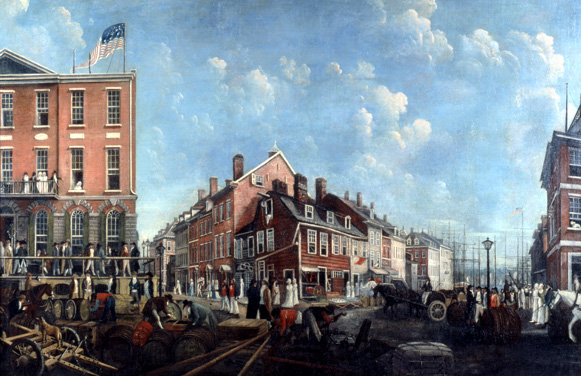
Within a year the brokers outgrew the tree. In 1793, a group of merchants and brokers opened the Tontine Coffee House at the corner of Wall and Water Streets. Financed through a tontine — a form of group annuity in which surviving members inherited the shares of those who died — the building provided a dedicated indoor space for securities trading. It was, in effect, the first trading floor in New York.
Trading at the Tontine was still informal by later standards. Brokers gathered in the main room, called out their bids and offers, and settled transactions on the basis of personal reputation. There was no written constitution, no formal call of securities, no fixed trading hours. But the move indoors represented a critical threshold: the transition from an open-air gathering that anyone could join to a defined physical space with implicit membership requirements. You had to be known and accepted to trade at the Tontine. That social filter reinforced the exclusivity the Buttonwood Agreement had established on paper.
Old World precedents: Amsterdam and London
New York's brokers were not inventing the idea of an organized securities exchange. They were, consciously or not, following paths that European merchants had blazed two centuries earlier.
In Amsterdam, the Dutch East India Company had created the first true stock market when it issued transferable shares in 1602. Trading in VOC shares took place at the Amsterdam Beurs, a purpose-built exchange building completed in 1611 by the architect Hendrik de Keyser. By the mid-seventeenth century, Amsterdam traders had developed short selling, options, futures, and most of the other instruments that modern markets would later reinvent (Petram, 2014).
London's market grew more organically. Stockbrokers were expelled from the Royal Exchange in 1698 for rowdy behavior and relocated to Jonathan's Coffee House in Exchange Alley. There, in a space not much larger than a modern living room, they created the institution that would become the London Stock Exchange. Like the Buttonwood brokers a century later, the London dealers established admission rules, minimum commissions, and mutual-trading obligations.
| Exchange | Founding event | Year | Initial securities |
|---|---|---|---|
| Amsterdam Beurs | VOC share trading begins | 1602 | VOC shares, government bonds |
| London (Jonathan's Coffee House) | Brokers expelled from Royal Exchange | 1698 | Government debt, joint-stock shares |
| New York (Buttonwood) | 24 brokers sign agreement | 1792 | US bonds, bank shares (~5 securities) |
What distinguished New York was timing. Amsterdam and London had taken decades — even centuries — to evolve from informal gatherings into regulated exchanges. New York compressed that evolution into a few years, propelled by the sudden creation of a national securities market through Hamilton's financial program and the shock therapy of the 1792 panic.
From Buttonwood to Board: the constitution of 1817
For twenty-five years after the Buttonwood Agreement, the brokers' organization remained loose and informal. Trading continued at the Tontine Coffee House, then at various rented rooms, with no written rules beyond the original two-clause compact. Disputes were settled by personal negotiation or, when that failed, by ostracism.
By 1817, the growth in trading volume and the increasing complexity of the market demanded something more formal. On 8 March 1817, the brokers adopted a written constitution and renamed their organization the New York Stock & Exchange Board. The constitution specified admission procedures — a candidate needed the approval of existing members — and established a structured "call" system for trading.
Under the call system, the president of the Board sat at a podium and called out each listed security in turn. When a stock was called, brokers who wished to buy or sell would announce their bids and offers from assigned seats. This was orderly, transparent, and slow. It also reinforced the exclusivity of the organization: only seated members could participate in the call, and seats were limited and increasingly valuable. By the 1830s, a seat on the Board sold for as much as $400 — a significant sum when a skilled artisan might earn $300 in a year (Geisst, 2004).
The call system had a further consequence that its creators may not have intended. Because trading was concentrated into a single sequential auction, prices were set transparently and recorded officially. These recorded prices could be published in newspapers, giving investors outside New York reliable information about market conditions. Price transparency attracted more investors, which increased trading volume, which made the Board more valuable, which attracted still more investors. A virtuous cycle had begun.
The telegraph revolution
Nothing transformed Wall Street more dramatically in the first half of the nineteenth century than the telegraph. When Samuel Morse sent his first message from Washington to Baltimore in May 1844, the implications for securities markets were revolutionary. Before the telegraph, price information traveled at the speed of a horse or a coastal sailing vessel — news from Philadelphia took a day; from Boston, two or three days; from New Orleans, two weeks. Brokers who received information first could trade on it before the market adjusted.
After the telegraph, prices in New York, Philadelphia, and Boston converged within minutes. A merchant in Cincinnati could know the price of federal bonds on Wall Street the same afternoon. By the 1850s, telegraph wires connected every major American city to New York, and the New York Stock & Exchange Board had become the undisputed center of American securities trading. Regional exchanges survived — Philadelphia, Boston, and later Chicago each maintained active markets — but New York set the national price for every major security.
Volume surged. In 1827, the Board had traded roughly 6,000 shares on a busy day. By 1835, that figure had risen to 8,500. After the telegraph, daily volume regularly exceeded 50,000 shares by the late 1850s. Railroad stocks — the technology darlings of the mid-nineteenth century — drove much of the growth, and by the eve of the Civil War, the Board listed dozens of railroad securities alongside government bonds, bank stocks, and insurance company shares.
Surviving the storms
An institution is tested not by its good days but by its bad ones. Between 1792 and 1907, the New York Stock Exchange — renamed as such in 1863 — endured at least six major financial panics, each of which threatened to destroy it. Each time, it survived. The cartel structure that the Buttonwood Agreement had created — exclusive membership, enforced commissions, mutual obligations — proved to be a source of resilience that open, unstructured markets could not match.
In the Panic of 1837, triggered by President Andrew Jackson's destruction of the Second Bank of the United States and the subsequent collapse of land speculation, the Board continued to operate even as hundreds of banks failed across the country. In the Panic of 1857 — a railway-driven credit crisis that spread from Ohio to London — the Board suspended trading only briefly before resuming operations. During the Civil War, the exchange thrived on government war bond trading, and its membership expanded dramatically.
The Panic of 1873, set off by the failure of Jay Cooke & Co. and the collapse of railroad financing, was arguably the worst financial crisis of the nineteenth century. The Board closed for ten days — the longest suspension in its history until that time. When it reopened, the cartel held. Members honored their obligations to one another, and the exchange emerged from the crisis with its institutional credibility intact.
Most dramatically, the Panic of 1907 — in which J.P. Morgan personally organized the rescue of the American financial system — demonstrated both the strengths and the limitations of the NYSE's self-regulatory model. Morgan could marshal the resources of the exchange's most powerful members precisely because they were members: bound by mutual obligations, sharing information through a common institution, and motivated to preserve the system on which their livelihoods depended.
The significance of a cartel
It is fashionable to view cartels with suspicion, and the NYSE's fixed-commission structure would eventually be dismantled — the Securities and Exchange Commission abolished fixed commissions on 1 May 1975, an event known to brokers as "May Day." But for almost two centuries, the cartel served a vital function. By guaranteeing brokers a minimum return on every transaction, it ensured that market-making remained a viable profession. Brokers who could count on earning their quarter-percent commission had an incentive to remain in the market during panics, to honor their counterparties' trades, and to maintain the institutional infrastructure that made orderly trading possible.
Without fixed commissions, the early American securities market might have remained what it was before the Buttonwood Agreement: a fragmented, untrustworthy bazaar dominated by curbstone brokers and auctioneers, where no investor could be sure that a quoted price was real or that a completed trade would be honored. The cartel imposed costs — higher commissions for investors — but it also created something that no amount of competition could have produced on its own: trust.
Legacy
From twenty-four men under a tree to the world's largest stock exchange by market capitalization — as of the early twenty-first century, the NYSE listed companies worth more than $25 trillion — is a trajectory that invites grand narratives. But the real lesson of the Buttonwood Agreement is smaller and more specific. Markets do not arise spontaneously from the desire to trade. They arise when a group of participants decides that the costs of disorder exceed the costs of organization, and agrees to bind itself by common rules.
Hamilton created the securities. Duer's crash demonstrated the need for structure. And twenty-four brokers, standing in the shade of a tree that no longer exists on a street that no longer resembles its former self, signed a two-sentence document that answered a question every market must eventually face: who do we trust, and on what terms?
Every exchange in the world — from the London Stock Exchange to the Tokyo Stock Exchange, from the Shanghai Stock Exchange to the Nasdaq — has had to answer that same question. Most have answered it in roughly the same way the Buttonwood brokers did: with membership rules, commission structures, and mutual obligations that sacrifice some freedom for the sake of reliability. The tree is gone, but the bargain endures — embedded in the architecture of every market where strangers agree to trade with one another and trust that the other side will pay.
Related
Historical records Learn more about our methodology.