The Roaring Twenties and the Rise of Popular Investing
Between 1920 and 1929, American industrial production nearly doubled. Automobiles rolled off Henry Ford's assembly lines by the millions, electric power reached homes and factories across the country, and a new consumer credit system let ordinary families buy radios, refrigerators, and washing machines on installment plans. For the first time in the nation's history, millions of Americans who had never owned a share of stock began pouring money into Wall Street, lured by a booming economy and the intoxicating conviction that prosperity had become permanent.
What followed was one of the most powerful bull markets in recorded history. From roughly 160 in early 1925, the Dow Jones Industrial Average climbed without interruption for four years, reaching 381.17 on September 3, 1929. Radio Corporation of America — one of the era's most celebrated growth stocks — rose from $12 per share in 1925 to $549 by that September, all without paying a single dividend. Investment trusts, the precursors of modern mutual funds, proliferated wildly: more than 500 new trusts were formed in 1929 alone, many of them layered atop one another in leveraged pyramids that magnified gains on the way up and would magnify losses on the way down.
The Role of Margin and Leverage
Margin lending was the fuel. Brokerage firms allowed customers to buy stocks by putting down as little as 10 percent of the purchase price, borrowing the rest at interest rates that climbed as high as 20 percent by the autumn of 1929. An investor who put down $1,000 to control $10,000 in stock would see their equity double on a mere 10 percent rise — but the mathematics worked with equal ferocity in reverse.
By the summer of 1929, brokers' loans had swollen to $8.5 billion, exceeding the entire amount of currency then in circulation in the United States. Federal Reserve Governor Roy Young recognized the danger and raised the discount rate from 3.5 to 5 percent in August. The Fed issued public warnings about excessive speculation. None of it mattered. Charles Mitchell, chairman of National City Bank of New York, openly defied the central bank by offering $25 million in fresh credit to the call money market, keeping funds flowing to speculators. "We feel that we have an obligation which is paramount to any Federal Reserve warning," Mitchell told reporters — a declaration that enraged the Fed but delighted Wall Street.
The Week That Shook the World
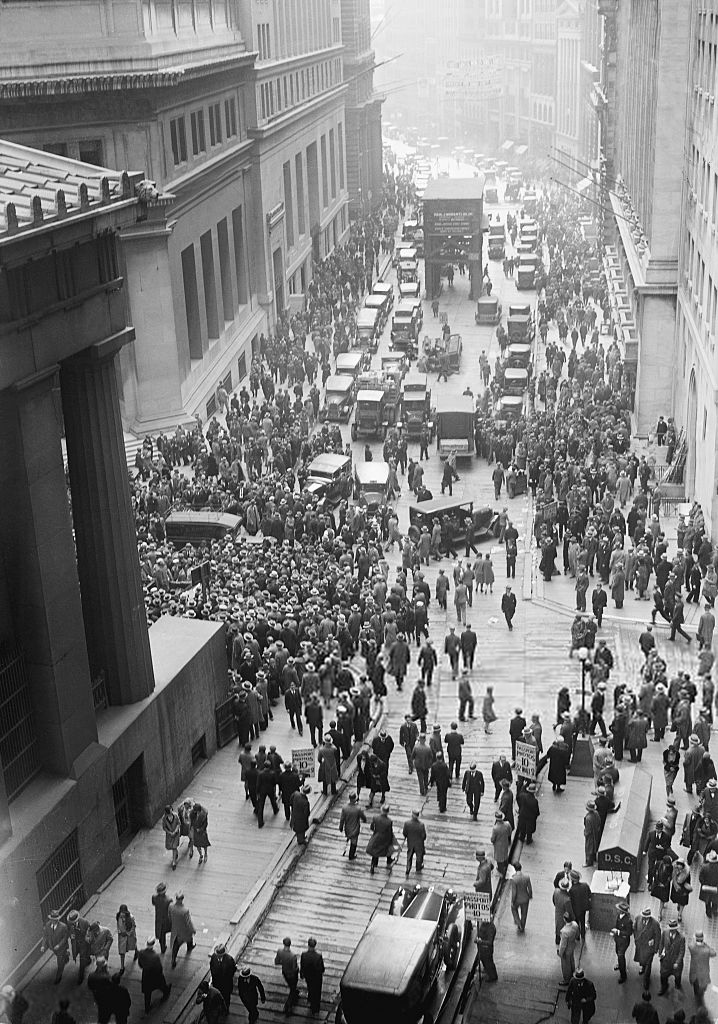
October 24, 1929 — Black Thursday — brought the first tremor. The market had been slipping from its September peak, but that Thursday morning a wave of selling overwhelmed every buyer on the floor. The ticker tape fell more than an hour behind, and by noon the Dow had dropped roughly 11 percent. Outside the New York Stock Exchange, a crowd gathered on Broad Street, watching, waiting, unsure what was happening inside.
At 23 Wall Street, in the offices of J.P. Morgan and Company, a group of the nation's most powerful bankers assembled over the lunch hour: Thomas Lamont of Morgan, Albert Wiggin of Chase National Bank, Charles Mitchell of National City, William Potter of Guaranty Trust. They pooled an estimated $240 million and dispatched Richard Whitney, vice president of the Exchange, to the trading floor. Whitney strode to the U.S. Steel post and conspicuously placed a bid for 10,000 shares at 205 — several points above the current price. He then moved from post to post, placing similar orders in other blue chips. Prices stabilized. Lamont emerged from the Morgan offices and told the press, with legendary understatement, that there had been "a little distress selling on the Stock Exchange."
| Date | DJIA Close | Daily Change | Cumulative from Peak |
|---|---|---|---|
| Sep 3, 1929 | 381.2 | — | — |
| Oct 24 (Black Thursday) | 299.5 | -6.3% | -21.4% |
| Oct 28 (Black Monday) | 260.6 | -13.0% | -31.6% |
| Oct 29 (Black Tuesday) | 230.1 | -11.7% | -39.6% |
| Nov 13, 1929 | 198.7 | — | -47.9% |
| Jul 8, 1932 | 41.2 | — | -89.2% |
The calm did not hold. On Monday, October 28, the Dow fell 38.33 points — nearly 13 percent — on enormous volume, and no banking consortium appeared to prop up prices. The following day brought the reckoning that gave the crash its name. On Black Tuesday, October 29, 1929, an estimated 16.4 million shares changed hands, a volume record that would stand for nearly four decades. The ticker tape ran more than two and a half hours behind the actual trading, which meant investors across the country had no way to know what their holdings were worth. By the close, the Dow had shed another 30.57 points. In just two days, the index had lost nearly a quarter of its value.
The Grinding Decline
Black Tuesday was not the end — it was the beginning. After a brief rally in early November, the market resumed its slide in a pattern that would torment investors for the next three years: sickening drops followed by temporary recoveries that lured money back in, each rally a trap. When the Dow climbed back to 294 in April 1930, optimists declared the worst was over. They were wrong by a factor that would have been unimaginable.
By July 8, 1932, the Dow Jones Industrial Average stood at 41.22 — a maximum drawdown of approximately 89 percent from its September 1929 peak. Total market capitalization of stocks listed on the NYSE collapsed from roughly $89 billion to $15 billion. Jesse Livermore, one of the era's most famous speculators, had actually profited from the crash by selling short — but he lost everything in subsequent market gyrations and took his own life in a Manhattan hotel room in 1940, leaving a note that read, "My life has been a failure."
The Banking Crisis and the Great Depression
A stock market crash, painful as it is, need not produce an economic catastrophe. What turned the crash of 1929 into the Great Depression was the banking crisis that followed. Commercial banks had invested heavily in the stock market — on their own accounts and on behalf of depositors — and the correlation breakdown during crises meant that the collapse in equity prices rendered thousands of institutions insolvent simultaneously. Between 1930 and 1933, more than 9,000 American banks failed, wiping out approximately $7 billion in depositors' savings and destroying the credit mechanisms that businesses depended on for day-to-day operations.
Credit contracted, consumer spending collapsed, and the economy spiraled downward. Industrial production fell by nearly half between 1929 and 1932. Unemployment rose from roughly 3 percent to 25 percent nationally, with some industrial cities enduring rates above 50 percent. International trade shriveled as nations erected tariff barriers — most notably the Smoot-Hawley Tariff Act of 1930, which raised duties on more than 20,000 imported goods and provoked retaliatory measures from trading partners around the world.
Milton Friedman and Anna Schwartz, in their landmark 1963 study A Monetary History of the United States, laid primary blame on the Federal Reserve. The central bank, they argued, had the tools to prevent the cascade of bank failures and chose not to use them, allowing the money supply to contract by roughly a third between 1929 and 1933. "The Fed was largely responsible for converting what might have been a garden-variety recession into a major catastrophe," Friedman wrote decades later — a verdict that shaped Federal Reserve thinking for the rest of the twentieth century and, arguably, drove the aggressive monetary response to the 2008 crisis.
Regulatory Transformation
Out of the wreckage came a new financial order. Congress passed the Securities Act of 1933, requiring companies to register securities offerings and provide detailed financial disclosures. The Securities Exchange Act of 1934 created the Securities and Exchange Commission to police the markets; Franklin Roosevelt appointed Joseph P. Kennedy — a man who knew every trick in Wall Street's book — as its first chairman. When asked why he picked a speculator to regulate speculators, Roosevelt reportedly replied, "Set a thief to catch a thief."
The Glass-Steagall Act of 1933 separated commercial banking from investment banking, prohibiting deposit-taking institutions from underwriting securities. The Federal Deposit Insurance Corporation, also created in 1933, guaranteed individual bank deposits — initially up to $2,500, a figure raised many times since — eliminating the incentive for panicked depositors to line up outside their banks at dawn.
Margin requirements changed most directly. The Federal Reserve gained authority to set initial margin requirements and raised them to 50 percent, meaning an investor could no longer control $10,000 in stock with just $1,000 down. That single reform altered the risk profile of equity markets more than any other measure enacted in the aftermath.
Legacy
The crash of 1929 drew a line through American financial history — between an era of largely unregulated markets and the modern regulatory state. One of the most severe tail risk events in financial history, its shadow has fallen across every subsequent crisis, from Black Monday in 1987 to the global financial meltdown of 2008. The institutional architecture erected in its wake — the SEC, the FDIC, federal oversight of margin lending — still forms the backbone of American financial regulation nearly a century later.
But the crash also reshaped something less tangible: the relationship between Americans and their government. Before 1929, the prevailing orthodoxy held that markets could regulate themselves and that Washington had no business interfering in economic life. After three years of breadlines and bank runs, that orthodoxy was dead. Roosevelt's New Deal programs expanded the federal government's role in economic stability and social welfare in ways that would have been politically unthinkable in the confident, freewheeling decade that preceded the fall.
Related
Historical records Learn more about our methodology.