On the morning of 9 April 1694, in a small alley behind Bloomsbury Square in London, a tall Scotsman named John Law ran his sword through the chest of a dandy called Edward "Beau" Wilson. The duel — if it was a duel at all and not simply an execution — lasted less than a minute. Wilson died on the cobbles. Law was arrested, tried at the Old Bailey, convicted of murder, and sentenced to hang. He was twenty-three. Within weeks he had bribed his way out of the King's Bench Prison, fled to Amsterdam, and begun the exile that would eventually make him, for a single astonishing year, the most powerful finance minister in Europe.
Law's journey from condemned duellist to Controller-General of France is the strangest career in the history of money. It is also one of the most instructive. Long before he ever set foot in the Banque Royale, he had worked out — in card rooms between Venice and Turin, in cheap lodgings in Genoa, in pamphlets rejected by the Scottish parliament — a theory of paper currency that the world would not accept for another two centuries. He is the subject, in other words, of two different biographies. One is the parable of the charming Scotsman who destroyed France. The other is the intellectual history of the first serious theorist of elastic fiat money. Both are true. Neither is complete on its own.
The Goldsmith's Son
John Law was born in Edinburgh in April 1671, the eldest son of William Law, a successful goldsmith-banker whose firm sat on the Lawnmarket at the top of the Royal Mile. In seventeenth-century Scotland, a goldsmith kept deposits, accepted bills, made loans, and assayed the coin of a dozen realms — a goldsmith's counting house was a working laboratory of the monetary system. By the time John was twelve his father had accumulated enough capital to purchase the estate of Lauriston on the Firth of Forth, giving the family the modest territorial title that the son would retain for the rest of his life. His father's death in 1683 left the boy an inheritance and, perhaps more importantly, the intuition that money was something one made, counted, and issued, not something fixed by the weight of metal.
Law attended Edinburgh's school of mathematics and appears to have been a prodigy at mental arithmetic. One family legend (Buchan, 2018) records that at fourteen he could reckon the odds at faro faster than any man in the city. In 1692, aged twenty-one, he sailed for London. The capital was in the first flush of the financial revolution — the Bank of England was about to be chartered, the first stock jobbers were gathering at Jonathan's Coffee House, and the combination of high-stakes gambling and high-stakes finance drew Law in completely. He dressed flamboyantly enough to earn the nickname "Jessamy John" (jessamy being seventeenth-century slang for a fop), courted at least two married women, and by his own later admission spent most of his days at the card tables of Jermyn Street.
The duel with Wilson was probably not over a card debt. Modern biographers (Murphy, 1997) reconstruct the episode as a quarrel over a woman, possibly Elizabeth Villiers, later Countess of Orkney, though the documentary record is thin. What is certain is that Law's escape from Newgate the following year was engineered at considerable expense and that he never again attempted to return to England as a free man, even after his eventual royal pardon in 1719. The murder conviction was the pivot of his life. It shut him out of London finance at the moment London finance was becoming the most interesting enterprise in Europe, and it forced him onto the Continent, where he had the fifteen years he needed to learn his trade.
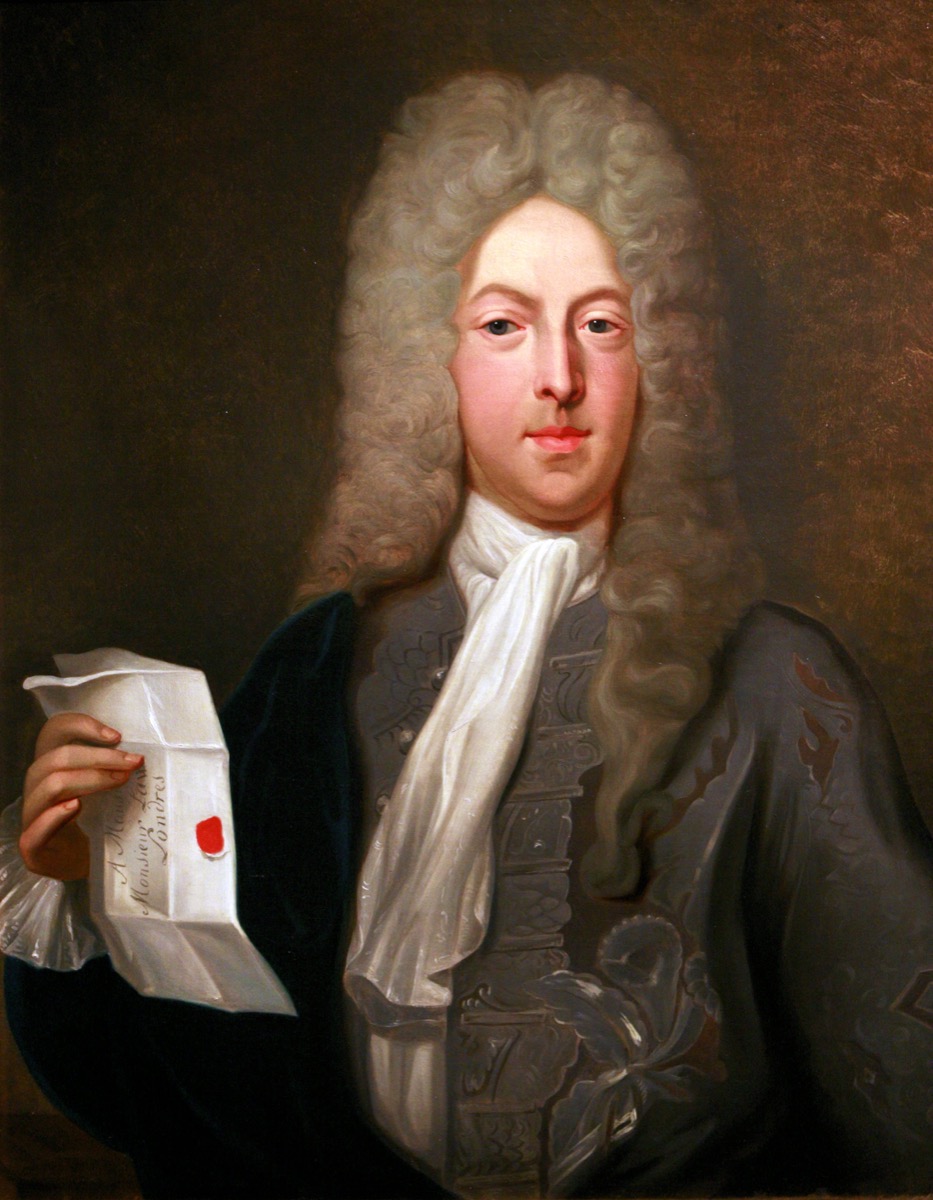
Fifteen Years at the Tables
Between 1695 and 1715 Law lived by his wits, which in practice meant by his cards. He passed through Amsterdam, Hamburg, Brussels, Venice, Genoa, Paris, Turin, and the spa towns of the Rhineland, supporting himself at pharaon, basset, and later at his own invention — a modified form of faro whose house edge he had calculated with mathematical precision. Contemporaries, as later reconstructed (Neal, 1990), regarded him not as a cheat but as something more disturbing: a man who had reduced chance to a spreadsheet. At Venice he was said to carry two large bags of gold coin to the Ridotto and wager them sixty thousand ducats at a time. The gambling was not, in his own view, a dissipation. It was empirical research.
Every major financial centre he visited taught him something. In Amsterdam he studied the Wisselbank and its bank-money-versus-specie agio — the mechanism by which an abstract ledger unit could trade at a premium to metallic coin. You can read the case for that innovation in the entry on the Bank of Amsterdam and the invention of bank money. In Venice he watched the Banco del Giro clear payments across the lagoon. In Paris he absorbed the workings of the royal tax farms. In Genoa he observed the Casa di San Giorgio, perhaps the closest thing early modern Europe had to a functioning central bank. By the time he returned briefly to Scotland in 1704, he had constructed in his head a composite picture of what a modern financial system ought to look like — and he knew that no European state yet had one.
Money and Trade Considered
Law's intellectual moment came in 1705, when he published in Edinburgh a short pamphlet titled Money and Trade Considered, with a Proposal for Supplying the Nation with Money. It is the single most important document of his life and, arguably, of early eighteenth-century monetary thought. One recent survey (Velde, 2007) describes it as the first coherent theoretical statement that money is a creature of law and credit rather than of metal — a position that would not become orthodox until John Maynard Keynes and Georg Friedrich Knapp restated it in the early twentieth century.
The argument of Money and Trade is simple enough to summarise. Trade is limited by the quantity of money. If a country has too little money, its land lies uncultivated, its workers idle, and its merchants unable to expand their operations. Silver is a defective monetary base because its supply is determined by the accidents of South American mining rather than by the needs of any particular economy. What a country needs is a bank empowered to issue paper notes backed by something whose value grows with productive activity — namely, land. "Domestic trade depends on money," Law wrote. "A greater quantity employs more people than a lesser quantity. A limited sum can only set a number of people to work proportionable to it."
Law proposed that the Scottish parliament charter a land bank, empowered to issue paper notes against the security of landed estates. The proposal was voted down in 1705 and again in slightly revised form in 1706. Scotland turned its attention instead to the Union with England, which offered a different route to monetary stability. Law, rebuffed, carried the book with him to the Continent and reissued it in Paris in 1713 and again in 1720 at the height of his power. A survey of the pamphlet literature two centuries later (Hamilton, 1936) judged that Money and Trade "anticipated the theory of bank money in substantially its modern form."
A Timeline of the Man
The arc of Law's life fits neatly into a single table. What it does not capture is the extraordinary compression of his public career: fifteen years of obscurity, then four years at the centre of European power, then nine years of quiet exile.
| Year | Event | Location | Role |
|---|---|---|---|
| 1671 | Born to William Law, goldsmith-banker | Edinburgh | Son and heir |
| 1683 | Father dies; inherits Lauriston estate | Edinburgh | Laird of Lauriston |
| 1692 | Moves to London | London | Gambler and dandy |
| 1694 | Kills Beau Wilson in duel; convicted | London | Condemned prisoner |
| 1695 | Escapes Newgate; flees to Continent | Amsterdam | Fugitive |
| 1695–1704 | Tours financial centres of Europe | Various | Professional gambler |
| 1705 | Publishes Money and Trade Considered | Edinburgh | Monetary theorist |
| 1706 | Land bank proposal rejected by Scottish parliament | Edinburgh | Rejected reformer |
| 1714 | Settles in Paris | Paris | Émigré financier |
| May 1716 | Granted royal charter for Banque Générale | Paris | Bank director |
| Aug 1717 | Founds Compagnie d'Occident | Paris | Company director |
| Dec 1718 | Banque Générale nationalised as Banque Royale | Paris | State bank director |
| 1719 | Receives royal pardon; merges trading companies | Paris | Head of Compagnie des Indes |
| Jan 1720 | Appointed Controller-General of Finances | Paris | Effective prime minister |
| May 1720 | Decrees 50% devaluation of notes and shares | Paris | Crisis manager |
| Dec 1720 | Flees Paris with eight hundred pounds | Brussels | Disgraced fugitive |
| 1721–1728 | Travels England, Netherlands, German states | Various | Private gentleman |
| 21 Mar 1729 | Dies of pneumonia | Venice | Exile |
Arrival in Paris and the French Fiscal Wreck
When Louis XIV died on 1 September 1715 after seventy-two years on the throne, he left behind a fiscal situation calculated in later work (Velde, 2007) at roughly 2.1 billion livres of sovereign debt against a national income perhaps one-third that size — something close to 125 per cent debt-to-GDP in modern terms. The five-year-old Louis XV was too young to rule. Power passed to Philippe, Duke of Orléans, a cultivated and cynical regent who had known Law socially at the gambling tables of the Palais Royal and had already read Money and Trade.
The Duke's first instincts were orthodox and brutal: he established a chamber of justice to claw back money from the tax farmers, partially defaulted on Louis XIV's short-term debt, and debased the coinage. None of it worked. By early 1716 the Regent was willing to listen to the Scotsman's radical alternative. On 2 May 1716, Law received a royal charter to open the Banque Générale, a private joint-stock bank authorised to issue paper notes redeemable on demand in coin of fixed weight. Its starting capital was six million livres, three-quarters payable in depreciated state debt — meaning that the bank, from its first day, was an instrument for monetising the obligations of the French crown.
What happened next is the subject of its own article in this series. The full chronology of the Banque Royale, the Mississippi scheme, and the crash sits in the Mississippi Bubble and the first paper-money catastrophe. The parallel British speculation of the same year is covered in the South Sea Bubble. What matters for Law the man is that by January 1720 he held, simultaneously, the governorship of the national bank, the directorship of the Compagnie des Indes (which monopolised French overseas trade and collected most of the nation's direct taxes), and the title of Controller-General of Finances. No foreigner and no commoner had ever held such a concentration of French state power. Saint-Simon, no admirer, conceded in his memoirs that "this Scotsman was at that moment the true regent of the kingdom."
The Crash, the Flight, and the Venetian Grave
Law had been appointed Controller-General in January 1720. By May he was already trying to contain a panic of his own making — he decreed a staged 50 per cent devaluation of both Banque Royale notes and Compagnie des Indes shares, reasoning that the paper had outrun the productive economy it was supposed to represent. The decree simply confirmed what holders had begun to fear. Run on the bank followed within days. In July Parisian mobs killed several people in the crush outside the bank's branch on the Rue Quincampoix. By November the Banque Royale had ceased payment. Law was dismissed, briefly imprisoned, and in December 1720 granted a passport to leave France. He crossed the border into the Austrian Netherlands with, by his own account, eight hundred English pounds and a single large diamond — the residue of one of the greatest fortunes in European history.
Source: Velde (2007), 'John Law's System and Public Finance'
The final nine years are a study in diminished returns. Law went to Brussels, then to Venice, then to London (where he was politely received at court after a long-delayed royal pardon), then back to Copenhagen, Hamburg, and finally back to Venice in 1726. He was welcome everywhere and important nowhere. His correspondence from these years — much of it preserved in the Murphy edition of his papers — reads as a running commentary on the monetary mistakes of other governments: the Bubble Act in England, the coinage debates in the German states, the continuing failures of French finance under Orléans's successors. He supported himself at the card tables as he had before, but the stakes were smaller and his old opponents had mostly retired. He died at his lodgings near the Campo San Moisè in Venice on 21 March 1729, aged fifty-seven, and was buried at the adjoining church. A satirical French epitaph soon made the rounds:
Ci-gît cet Écossais célèbre, / Ce calculateur sans égal, / Qui par les règles de l'algèbre / A mis la France à l'Hôpital.
The Theorist's Afterlife
For a century after his death, Law was almost universally dismissed as a charlatan. The assessment began to turn with Joseph Schumpeter, who placed Law in his History of Economic Analysis "in a class by himself" as a monetary thinker — ahead of his century and, on certain points, ahead of the twentieth. Keynes, more cautiously, admired the ambition of the Système while treating its execution as a cautionary case. Hayek, predictably, regarded Law as the patient zero of every subsequent episode of fiat-money overissue. The modern verdict, set out most carefully in recent scholarship (Murphy, 1997; Velde, 2007), is that Law was the first European to grasp four propositions that every central banker now takes for granted: that money supply should be elastic rather than fixed, that paper credit can be as sound as metal if properly backed, that a national bank can be an instrument of fiscal policy, and that the central-bank–sovereign-debt linkage is both powerful and dangerous.
The institutional inheritance is direct. Peel's Bank Charter Act of 1844, the founding of the Banque de France in 1800, and the debates around the first Federal Reserve Act in 1913 all revisit problems that Law first framed. The model of public credit built a century later by Alexander Hamilton in the United States — described in Hamilton's dinner-table bargain and the birth of American credit — is in substance the Law system stripped of its share-issuance engine and fitted with a functioning legislature. Even the founding of the Bank of England in 1694, which Law had watched from the other side of the counter as a young Londoner, looks in retrospect like the orthodox twin of his later French experiment.
Law died believing he had been right in theory and unlucky in execution. On that specific point, most serious historians now agree with him. What he could not have foreseen is that the theory would eventually win, and that the institution he had tried to build in Paris in 1720 — a bank empowered to issue notes against the productive capacity of a whole nation — would by the twentieth century become the ordinary machinery of government everywhere. The Scottish gambler got the idea three hundred years before its time. He also got it almost exactly right.
Related
Historical records Learn more about our methodology.