The Seeds of Catastrophe: War and Versailles
Imperial Germany financed the First World War overwhelmingly through borrowing rather than taxation, gambling that victory would let it impose reparations on the defeated Allies — much as France had paid indemnities to Prussia after the Franco-Prussian War of 1870-1871. By the armistice of November 1918, Germany's national debt had ballooned from 5 billion marks to 156 billion marks, and the mark, which had traded at 4.2 per U.S. dollar before the war, had already depreciated to roughly 14 per dollar.[^1]
Versailles made everything worse. The London Schedule of Payments in May 1921 fixed Germany's reparations obligation at 132 billion gold marks — approximately $33 billion — to be paid in annual instalments of 2 billion gold marks plus 26 percent of German exports. That total represented roughly two and a half times Germany's entire annual GDP. John Maynard Keynes, who had served as a British Treasury representative at the peace conference, resigned in protest and published The Economic Consequences of the Peace (1919), warning that the reparations would destabilize not merely Germany but all of Europe.
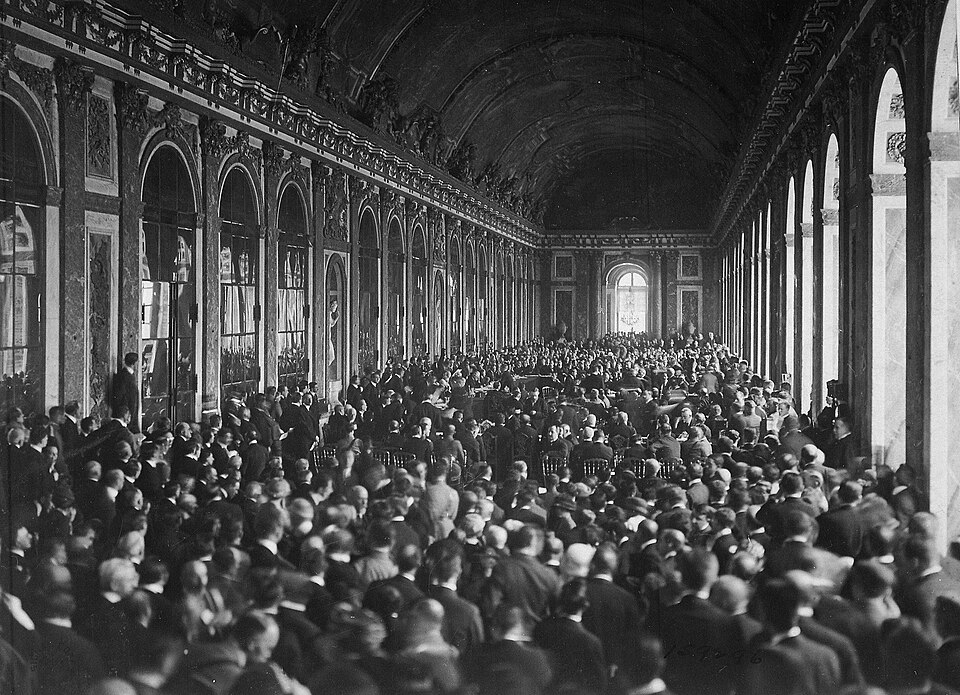
Germany made its first billion-mark payment in June 1921, but the effort strained the budget to its limits. Unable to raise sufficient revenue through taxation in a battered postwar economy, the government increasingly turned to the Reichsbank to monetize its deficits — in plain terms, to print money. Reichsbank president Rudolf Havenstein accommodated the government's needs by expanding the money supply at an accelerating rate. Between the end of 1919 and the end of 1921, the quantity of marks in circulation roughly tripled.
The Ruhr Crisis and the Point of No Return
In January 1923, France and Belgium occupied the Ruhr — Germany's industrial heartland, responsible for roughly 80 percent of its coal and steel production — after Germany fell behind on reparations deliveries of coal and timber. Chancellor Wilhelm Cuno declared a policy of passive resistance (passiver Widerstand), urging Ruhr workers to refuse all cooperation with the occupiers. To sustain millions of idle workers and their families, the government simply printed money on a scale that had no precedent.
This was the moment from which there was no return. The Reichsbank was now printing currency not merely to cover ordinary deficits but to finance an entire region's economic shutdown. Paper marks in circulation — roughly 1.3 trillion at the end of 1922 — exploded to 496 quintillion (496,000,000,000,000,000,000) by November 1923.[^2] Printing presses ran day and night, and the Reichsbank contracted with private firms to keep pace with demand. At the peak, the bank was issuing notes worth several quadrillion marks per day.
Source: Statistisches Reichsamt; Holtfrerich (1986), The German Inflation 1914-1923
Daily Life in the Inferno
What hyperinflation meant in practice defied comprehension. Workers were paid twice daily — once at midday, once at the end of the shift. Wives met their husbands at the factory gate at noon, stuffed the morning's wages into suitcases or wheelbarrows, and sprinted to the shops to buy anything of tangible value before the afternoon's price revisions rendered the cash worthless. Shopkeepers changed prices multiple times a day. Restaurants stopped printing menus because prices would be obsolete by the time the food arrived.
| Date | Price of a loaf of bread (marks) | USD/Mark exchange rate |
|---|---|---|
| January 1919 | 0.26 | 8.9 |
| January 1921 | 1.35 | 64.9 |
| January 1922 | 3.50 | 191 |
| January 1923 | 250 | 17,972 |
| July 1923 | 3,465 | 353,000 |
| September 1923 | 1,512,000 | 98,860,000 |
| October 1923 | 1,743,000,000 | 25,260,000,000 |
| November 1923 | 201,000,000,000 | 4,200,000,000,000 |
The German middle class — the Mittelstand of small business owners, professionals, civil servants, and pensioners — was annihilated. A lifetime of savings could not buy a single meal. Pensioners who had diligently set money aside for decades found their monthly payments unable to purchase a postage stamp. Mortgages and debts could be paid off with worthless currency, enriching debtors at the expense of creditors in a vast, involuntary wealth transfer that shattered social trust. Those who owned tangible assets — land, factories, foreign currency — came through relatively intact, while those who had trusted the financial system were ruined.
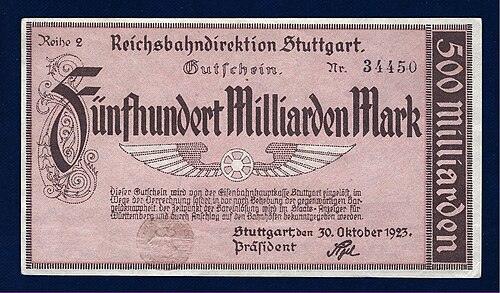
Barter replaced monetary exchange across much of daily life. Farmers refused paper money for their produce, preferring to swap food for shoes, tools, or fabric. City dwellers rode trains to the countryside to trade family heirlooms for potatoes. A piano might fetch a sack of flour. Every transaction became an exercise in desperation and mutual suspicion.[^3]
The Rentenmark Miracle
By autumn 1923, Germany was coming apart. Political extremism surged — Adolf Hitler launched his Beer Hall Putsch in Munich on 8-9 November, and communist uprisings erupted in Saxony, Thuringia, and Hamburg. The republic appeared to be dissolving.
On 15 November 1923, Chancellor Gustav Stresemann's government introduced the Rentenmark, a temporary currency backed not by gold but by a mortgage (Grundschuld) on all German industrial and agricultural land. Hjalmar Schacht, appointed Currency Commissioner and soon thereafter Reichsbank president, was the man tasked with making it work.
Schacht's approach was as much psychological as monetary. He imposed an absolute ceiling on Rentenmarks in circulation — 3.2 billion — and refused every government request to print more. The exchange rate was set at one Rentenmark to one trillion old papiermarks, and at 4.2 Rentenmarks to the U.S. dollar — the same rate that had prevailed before the war. The land backing was largely symbolic, since the mortgage could not realistically be foreclosed, but it gave the public a tangible anchor for confidence.
Prices stabilized almost immediately. An inflation that had seemed unstoppable ended within days. Germans called it the Wunder der Rentenmark. In August 1924 the Rentenmark was supplemented by the Reichsmark, a new gold-standard currency introduced under the Dawes Plan, which also restructured reparations payments with the help of American loans.
The Long Shadow: From Weimar to the Bundesbank
Hyperinflation burned itself into German collective memory. The destruction of savings, the humiliation of carrying worthless banknotes, the social upheaval that followed — these became foundational experiences for a generation that would later rebuild the nation. The trauma ran so deep that it shaped German economic thinking for the rest of the century and beyond.
When the Federal Republic was established in 1949, the Bundesbank — formally the Bank deutscher Lander, renamed in 1957 — received an explicit mandate to maintain price stability. That mandate reflected a national consensus, forged in 1923, that inflation was the supreme economic evil. The Bundesbank became the most inflation-hawkish central bank in the developed world, consistently putting price stability ahead of employment or growth, even when doing so provoked political controversy.
This institutional memory carried forward into the design of the European Central Bank. When the Maastricht Treaty established the framework for European monetary union in 1992, Germany insisted the ECB be modelled on the Bundesbank, with price stability as its primary objective and institutional independence from political pressure. The ECB's headquarters was placed in Frankfurt, the Bundesbank's seat. The ghost of 1923 was present in every clause. The parallels with the Volcker Shock — another episode where the trauma of inflation justified severe economic medicine — are striking, though the American experience was mild by comparison.
Weimar also stands as a cautionary tale about the nature of money itself. The lesson runs deeper than "governments should not print recklessly." It is that the value of money rests on collective belief, and once that belief shatters — as it did in Germany in 1923 — restoring it demands not just technical measures but a fundamental rebuilding of institutional credibility. The architects of the Bretton Woods system understood this well, designing the postwar monetary order in large part to prevent a repetition of the interwar chaos.
The echoes reach further still. The crash of 1929 and the Great Depression that followed were shaped by the reparations tangle and the financial instabilities hyperinflation had exposed. The political radicalization it fueled — while the final collapse of the Weimar Republic owed more to the Depression-era deflation of 1930-1932 than to the inflation of 1923 — created a reservoir of bitterness toward democratic institutions that extremists would later exploit with lethal effect.[^4]
A century later, Weimar remains the most widely cited example of what happens when a government loses control of its currency — not as an abstraction, but as a lived catastrophe whose consequences reverberate in the institutional architecture of central banking to this day.
Related
Historical records Learn more about our methodology.