A Country Burning Its Money to Stay Warm
In the winter of 1945-46, residents of Budapest noticed something new in the street markets that had reopened amid the rubble of the siege. Vendors were quoting bread and lard in tens of thousands of pengo, then hundreds of thousands, then by spring in millions. Tram conductors stopped issuing tickets because the cost of printing them exceeded the fare. A retired civil servant later told the historian Bertrand Nogaro that his pension, large enough in late 1944 to live modestly, by July 1946 would not buy a single egg in the morning market — and would buy nothing at all by sundown. Eyewitnesses from the period agreed on one image: in the final weeks of the pengo, paper money was being used to light stoves, because banknotes were cheaper than firewood (Nogaro, 1948).
This is not a metaphor. Hungary in 1946 produced the only hyperinflation in modern history where a daily inflation rate of roughly 207 percent was sustained for weeks on end, with prices doubling on average every fifteen hours. By comparison, the Weimar inflation of 1922-23 — the canonical case in every monetary economics textbook — peaked at a monthly rate of about 29,500 percent, equivalent to prices doubling every 3.7 days. Hungary's collapse moved an order of magnitude faster.
How a country of fewer than nine million people manufactured the worst monetary failure ever recorded is a story that begins not in a printing press but in the geography of post-war Eastern Europe.
A Devastated Economy Under Soviet Occupation
When the front rolled west across Hungary in the autumn and winter of 1944-45, the country lost much of its productive capacity. The siege of Budapest alone killed at least 38,000 civilians and reduced large sections of the capital to ruins. Industrial output had fallen to roughly 30 percent of its pre-war level by mid-1945. Roughly 40 percent of the national wealth, by the National Bank's later estimate, was destroyed or carried off. Rolling stock, machine tools, livestock, and grain stockpiles were removed eastward by withdrawing German forces and then by occupying Soviet units. Cagan (1956), in the canonical statistical study of twentieth-century hyperinflations, treated Hungary as a separate category precisely because no other case in his dataset combined such physical destruction with such persistent fiscal monetisation.
Three financial burdens then fell on what was left. The first was the cost of supporting roughly 600,000 Soviet troops stationed on Hungarian soil — billeting, rations, fuel, and local currency requisitions, all charged against the Hungarian budget. The second was reparations under the armistice of 20 January 1945 and the eventual 1947 Treaty of Paris: $300 million payable in goods to the Soviet Union, Czechoslovakia, and Yugoslavia over six years, valued at 1938 prices and with explicit Soviet penalty clauses for late delivery. The third was the cost of internal demobilisation, refugee resettlement, and the rebuilding of basic infrastructure.
Estimates by Hungarian economists working under the Smallholders Party government — the dominant partner in the post-war coalition until 1947 — suggested that occupation costs and reparations alone consumed somewhere between 25 and 50 percent of national income in 1945 and the first half of 1946 (Siklos, 1991). These were not nominal claims that could be inflated away. They were physical deliveries of coal, steel, rolling stock, and manufactured goods, denominated in 1938 prices, that had to be produced in real terms regardless of the state of the pengo.
The Bank as Cashier of the State
The Hungarian National Bank, founded in 1924 as part of the League of Nations stabilisation that ended the country's first hyperinflation, retained its legal independence on paper. In practice, from the summer of 1945 onward, it functioned as a cashier of the Treasury. Government deficits were monetised by direct advances against Treasury bills that no one expected the Treasury to redeem. By June 1946, currency in circulation had risen from roughly 25 billion pengo at the end of the war to a nominal figure that overflowed standard accounting registers — a single deposit ledger entry from late July recorded a balance with twenty-seven digits.
What makes the Hungarian case analytically distinct from earlier hyperinflations is the technical structure imposed on top of this monetisation. By the spring of 1946, the authorities recognised that printing ever-larger denominations of plain pengo would lose the public faster than the press could keep up. So they layered new units on top.
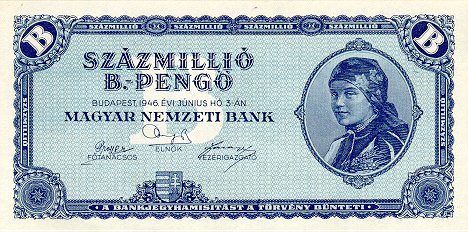
In December 1945 the milpengo was introduced — 1 million pengo as a single accounting unit. In June 1946 came the b.-pengo, or billion-pengo, where "billion" followed the European long scale: one b.-pengo was 10^12, or one million million, pengo. Wages, taxes, and bank balances were redenominated. Three weeks after that, in July 1946, the National Bank introduced the adopengo, or "tax pengo" — a quasi-currency indexed daily to the cost of living and used for tax payments and government wages. By the end of July the official tax-pengo conversion stood at roughly 2 x 10^21 ordinary pengo per adopengo and was rising hourly.
The Numbers That Outran Comprehension
To grasp the velocity of what happened next, it helps to fix the dollar exchange rate at key points. In January 1945, before the rebuilding spree, one US dollar bought roughly 100 pengo on the Budapest curb market. By December 1945, the rate had moved to approximately 128,000 pengo. By April 1946, the dollar fetched some 60 billion. By the morning of 1 August 1946, the day the forint replaced the pengo, the official exchange rate stood at 4 x 10^29 pengo for a single forint, with the forint itself pegged at 11.74 to the dollar.
The data above are monthly snapshots reconstructed from National Bank curb-market quotations cited in Bomberger and Makinen (1983). The acceleration in May and June 1946 reflects the regime change between the b.-pengo phase and the brief adopengo phase. A linear plot of these numbers is meaningless — by the final reading the dollar quote contains thirty digits. The story is the slope on a logarithmic chart, which steepens almost vertically in the final two months.
Daily life adjusted in ways that recall the more extreme passages of the Zimbabwe collapse of 2007-08 but compressed into a far shorter window. Workers in Budapest factories demanded twice-daily pay. Wages were spent at lunch hour because the same wages by evening would not buy bread. A 1946 contemporary report quoted by Nogaro described shopkeepers chalking prices on slates and erasing them every few hours: "Yesterday's price is an insult; this morning's price is already history."
Denominations Beyond the Imagination
The Hungarian National Bank's print room produced a sequence of denominations that has no parallel in monetary history.
| Date issued | Note | Face value (pengo) | Approx. USD value at issue |
|---|---|---|---|
| 24 May 1946 | 10,000 milpengo | 10^10 | $0.30 |
| 3 Jun 1946 | 100 million milpengo | 10^14 | $0.06 |
| 12 Jun 1946 | 1 b.-pengo | 10^12 | $0.02 |
| 19 Jun 1946 | 10,000 b.-pengo | 10^16 | $0.10 |
| 3 Jul 1946 | 1 million b.-pengo | 10^18 | $0.02 |
| 11 Jul 1946 | 100 million b.-pengo | 10^20 | $0.20 |
| Designed only | 1 milliard b.-pengo | 10^21 | (never issued) |
Each note in the table cost more to print than the goods it could buy within days of release. The 100 million b.-pengo — face value of 100 quintillion in the short-scale convention used in American English — was put into circulation on 11 July 1946 and withdrawn from active distribution on 31 July, only twenty days later. The note depicted a peasant woman with sheaves of wheat on the obverse and the Hungarian Parliament Building on the reverse. The 1 milliard b.-pengo, or 10^21 pengo, was fully designed and printed but never issued: by the time it would have been needed, the forint had already replaced the entire structure.
The Adopengo: Indexation as Last Resort
The adopengo deserves a separate paragraph because it represents one of the more interesting institutional inventions of the episode. Introduced on 8 July 1946, it was an accounting unit whose daily exchange value into ordinary pengo was set by the National Bank based on a cost-of-living index. Tax obligations and government wages were redenominated in adopengo and converted back into ordinary pengo at that day's rate. The effect was to insulate the fiscal authorities from inflation — they could collect taxes in real terms while everyone else's nominal balances were vapourising.
For ordinary citizens, the adopengo functioned briefly as a parallel currency. Notes denominated in adopengo from 10,000 up to 100 million were printed and circulated alongside the b.-pengo series. By late July, the adopengo accounted for roughly 80 percent of the real value of money in circulation, even though the ordinary pengo retained legal-tender status (Siklos, 1991). Hungary had effectively repudiated its own currency from within the central bank.
The Forint Reform and the Return of Trust
The decision to abandon the pengo was taken jointly by the coalition government and the Allied Control Commission in late June 1946. Hungarian gold reserves of approximately 30 metric tonnes, seized by retreating German forces in 1944 and held in US Army custody in Frankfurt, were repatriated in stages from June onward. Reparations deliveries were renegotiated under Soviet pressure to allow stocks of finished goods to back the new currency rather than be exported. A balanced budget was imposed with savage tax increases and a 50 percent reduction in nominal public-sector employment.
On 1 August 1946 the forint became legal tender at the rate of 4 x 10^29 pengo to one forint — the largest exchange ratio in monetary history. Bomberger and Makinen (1983) showed that the stabilisation was effectively instantaneous in the wholesale prices that the central bank tracked: the index, which had been rising by hundreds of percent per day in late July, was flat by the second week of August. Within a quarter, retail prices had stabilised as well. The forint was pegged to the dollar, partially backed by recovered gold, and ringed by a regime of strict controls on credit growth by the National Bank.
The political price of the stabilisation was a deepening Soviet grip on Hungarian institutions. Mátyás Rákosi's Communist Party used the reform's authority to consolidate control of the economy through what became known as "salami tactics," and by 1948 Hungary was a one-party state. The forint survived; the parliamentary democracy that introduced it did not.
Why Cagan Used Hungary
Phillip Cagan's 1956 paper for Milton Friedman's Studies in the Quantity Theory of Money established the modern statistical definition of hyperinflation — a monthly inflation rate exceeding 50 percent — and tested the demand for real money balances against expected inflation across seven historical cases. Hungary 1945-46 sat at the extreme end of his dataset, with a monthly inflation rate that peaked in July 1946 at an estimated 4.19 x 10^16 percent, or roughly 42 quadrillion percent. The Hungarian data points dominated the regression coefficients to such a degree that Cagan reported separate results with and without them.
What Cagan inferred from the Hungarian case has aged well. The demand for real money balances collapsed exponentially as expected inflation rose — at the peak, real cash balances in pengo were less than 1 percent of their pre-war level — but did not go to zero. People held some pengo for the time it took to convert wages into goods, and that residual demand explains why printing more notes still bought the government real resources at the very end, even as the marginal value of each note approached the cost of the paper.
The Hungarian collapse also illustrated the central message that links all great monetary failures from the kipper- und wipperzeit of 1619-23 through the French assignats of 1789-96 to Weimar and Zimbabwe: hyperinflation is a fiscal phenomenon transmitted through a central bank that has lost the institutional independence to refuse Treasury demands. The technical apparatus of milpengo, b.-pengo, and adopengo was an attempt to manage the consequences of a political failure. It could not substitute for the political decision to stop borrowing from the press.
Eighty years on, the pengo lives in the back rooms of numismatic exhibitions and in central-bank training material for stabilisation programmes. The 100 million b.-pengo note — a piece of paper that briefly represented a hundred quintillion units of an extinct currency — is sold to collectors in Budapest for the price of a modest dinner, which feels about right.
Related
Historical records Learn more about our methodology.