The Great Inflation
By the late 1970s, an inflationary crisis was strangling the American economy. Consumer prices had risen at an average of 3.2% during the 1960s, a rate that seemed almost quaint by the time OPEC quadrupled crude oil prices in 1973 and pushed inflation above 7%. A second oil shock — triggered by the Iranian Revolution in 1979 — sent it screaming past 11%. Producer prices were climbing at over 15% a year. Since 1967, the dollar had lost half its purchasing power.
Savers watched their nest eggs shrink in real terms; a bank account paying 5.25% interest was actually losing money once inflation was subtracted. Wages chased prices upward as workers demanded cost-of-living adjustments, which only fed the spiral further. Businesses gave up on long-term planning because no one could predict what borrowing would actually cost in real terms. "Stagflation" — the poisonous blend of rising prices and rising unemployment — entered everyday language, describing a condition that Keynesian economics had deemed impossible.
Much of the blame belonged to the Federal Reserve itself. Under Arthur Burns (1970-1978) and briefly G. William Miller (1978-1979), the Fed had repeatedly tightened policy when inflation surged, only to reverse course the moment economic slowdowns generated political heat. Each cycle of tightening and retreat ratcheted inflation expectations higher. Markets and wage-setters bet that the Fed would always flinch before inflicting real pain — and they were right every time.
Volcker Takes Charge
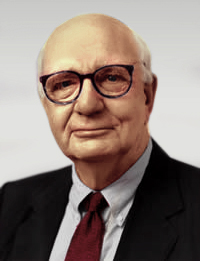
Paul Adolph Volcker was appointed Chairman of the Federal Reserve Board by President Jimmy Carter on August 6, 1979. Six feet seven inches tall, perpetually wreathed in cigar smoke, and utterly indifferent to political popularity, Volcker had spent decades at the Treasury Department and the Federal Reserve Bank of New York. He understood monetary mechanics cold — and he understood what would happen if inflation were allowed to entrench itself permanently.
He moved fast. On October 6, 1979 — barely two months into the job — Volcker announced a radical shift in operating procedures. Instead of targeting the federal funds rate directly, the approach that had allowed previous Fed chairs to ease off under political pressure, the central bank would now target the growth of the money supply and let interest rates land wherever they might. "We are not setting rates," Volcker could now tell Congress. Rates were merely the byproduct of money-supply control. It was a technical change, but its real purpose was political: to provide cover for the brutally high rates Volcker knew would be required.
In practical terms, the shift was a masterstroke. It allowed Volcker to disclaim direct responsibility for interest rates while pursuing exactly the policy he wanted — rates high enough to crush inflation regardless of the economic wreckage along the way.
The Monetary Vise
Results came immediately, and they were brutal. By April 1980, the federal funds rate had surged from 11% to 17.6%. It briefly eased during spring 1980 when Carter imposed credit controls that Volcker privately opposed, then resumed its climb. In January 1981 the rate hit 19%. By June it reached an all-time peak of 20%.
Banks were charging their best borrowers 21.5% — the prime rate in December 1980. Mortgage rates soared above 18%. For an ordinary family trying to buy a home, monthly payments on a $100,000 mortgage at 18% would run approximately $1,507, nearly double the $805 at the 9% rates of a few years earlier. Home sales collapsed. Auto sales collapsed. Business investment collapsed.
| Date | Federal Funds Rate | CPI Inflation (YoY) | Unemployment Rate |
|---|---|---|---|
| Aug 1979 | 10.9% | 11.8% | 5.9% |
| Apr 1980 | 17.6% | 14.7% | 7.0% |
| Jul 1980 | 9.0% | 12.8% | 7.8% |
| Jan 1981 | 19.0% | 11.8% | 7.5% |
| Jun 1981 | 20.0% | 9.6% | 7.5% |
| Dec 1981 | 12.4% | 8.9% | 8.5% |
| Jun 1982 | 14.2% | 6.7% | 9.8% |
| Nov 1982 | 9.2% | 4.6% | 10.8% |
| Dec 1983 | 9.5% | 3.2% | 8.3% |
Source: Federal Reserve Bank of St. Louis (FRED), Federal Funds Effective Rate
The Human Cost
What followed was the deepest recession since the Great Depression. GDP contracted by 2.7% between the third quarter of 1981 and the fourth quarter of 1982. Unemployment climbed from 7.2% in July 1981 to 10.8% in November 1982 — twelve million Americans without work, a number not seen since the 1930s.
Pain concentrated where it always does in a rate-driven contraction: the interest-rate-sensitive sectors. Housing starts fell from 2 million units in 1978 to under 1 million in 1982. Auto sales — already battered by Japanese competition — dropped to their lowest level since 1961. Across the farm belt, high rates inflated the cost of servicing agricultural debt while a strong dollar made American exports less competitive abroad. Farm bankruptcies reached levels not seen in half a century.
In the industrial heartland — steel towns, auto cities, heavy-manufacturing corridors — the damage amounted to a structural collapse. Youngstown, Gary, Flint, Pittsburgh: these cities lost populations and industries that would never return, and "Rust Belt" entered the American vocabulary. Farmers drove tractors to Washington in protest convoys. Construction workers mailed two-by-fours to the Federal Reserve Board. A lumber dealer in Mississippi sent a small coffin.
Volcker received death threats. Congressional pressure was immense, with both Democrats and Republicans introducing legislation to strip the Fed of its independence or force rate cuts. Volcker ignored them all. When asked whether the recession had been deliberately caused, he replied with characteristic bluntness: the Fed had not caused the recession — inflation had caused it, and the recession was the unavoidable cost of curing the disease.
Breaking the Back of Inflation
It worked. CPI inflation, which had peaked at 14.8% in March 1980, fell to 6.2% by the end of 1982 and reached 3.2% in 1983. More importantly, inflation expectations — the forward-looking beliefs about future prices that drive wage demands, price-setting, and investment decisions — broke sharply. Bond markets that had demanded double-digit yields throughout the late 1970s began accepting lower rates. A long-term decline in interest rates that began in the early 1980s would continue, with interruptions, for nearly four decades, fueling a historic bull market in bonds and equities alike.
Disinflation on this scale was not free. Economists who have estimated the "sacrifice ratio" — the cumulative output lost for each percentage point of reduced inflation — put the cost of the Volcker disinflation at 4% to 6% of GDP per point. Total output losses have been estimated at roughly $1.5 trillion in 2023 dollars. Those costs fell hardest on blue-collar workers, farmers, and minority communities — the groups with the least influence over monetary policy and the least ability to hedge against its consequences.
The Legacy of Credibility
Volcker's achievement reached far beyond the numbers. He demonstrated that a central bank, if it refused to blink, could break entrenched inflation — a proposition that had been in serious doubt by the late 1970s. In doing so, he established the principle of central bank credibility: a central bank's long-term effectiveness depends on its willingness to accept short-term pain, and once credibility is earned, it lowers the cost of every future policy action because markets trust the institution's commitments.
That insight reshaped central banking for a generation. Where the Glass-Steagall framework had defined the regulatory architecture of banking, Volcker defined its behavioral architecture. His successors — Greenspan, Bernanke, Yellen — inherited a Fed whose inflation-fighting credibility had been purchased at enormous cost and were generally careful not to squander it. Inflation targeting, the dominant framework at central banks worldwide by the early 2000s, descends directly from what Volcker proved: that anchoring inflation expectations is the single most important function a central bank performs.
Yet the Volcker Shock also stands as a sobering case study in who pays for macroeconomic correction. Low inflation's benefits — stable conditions for long-term investment, predictable real wages, reliable pension values — spread broadly across society. Its costs concentrated on the most vulnerable. Steel towns did not vote for 20% interest rates, and farm families did not choose to lose their land so that bond markets could regain confidence. Whether the tradeoff was justified remains not merely an economic question but a moral and political one — and the argument has never really ended.
Related
Historical records Learn more about our methodology.