An Institution of Imperial Pedigree
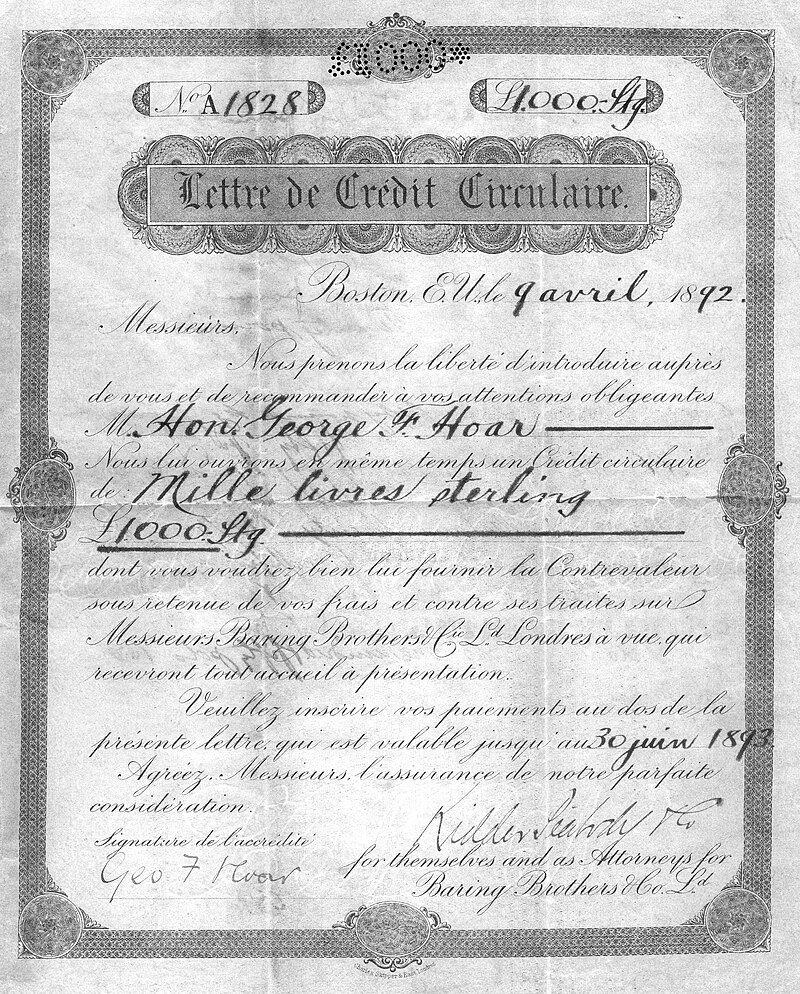
Barings Bank was not merely old. It was woven into the fabric of British imperial history. Founded by Sir Francis Baring in 1762, the firm rose to prominence as one of the great merchant banks of the City of London during an era when Britain commanded the world's financial system. In 1803, Barings arranged the financing for the Louisiana Purchase — the transaction through which the United States acquired 828,000 square miles from Napoleonic France for $15 million, one of the most consequential real estate deals in history. Throughout the nineteenth century the bank financed governments on both sides of the Atlantic, earning a description from the Duc de Richelieu as one of the six great powers of Europe — alongside England, France, Austria, Prussia, and Russia.
By the late twentieth century, Barings had survived the Baring Crisis of 1890 — when overexposure to Argentine sovereign debt nearly destroyed the firm and required a Bank of England rescue — along with two world wars and countless market upheavals. It served as banker to Queen Elizabeth II. The Barings name carried an aura of permanence that few global institutions could match. That aura bred complacency, and the complacency proved fatal.
The Rise of Nick Leeson
Nicholas William Leeson was born in Watford, England, in 1967, the son of a plasterer. He left school at eighteen without a university degree and entered finance through the back office — the administrative and settlements side of banking, a world away from the glamour of the trading floor. He worked as a settlements clerk at Coutts & Co., moved to Morgan Stanley to gain experience in futures and options settlement, then joined Barings Securities in 1989.
His back-office expertise proved unexpectedly valuable. In 1992 Barings sent him to Singapore to manage settlements at Barings Futures Singapore (BFS), which traded on the Singapore International Monetary Exchange (SIMEX). Leeson quickly impressed management by sorting out operational problems, and his role expanded: he would not only manage settlements and accounting but also execute trades on the SIMEX floor. This dual role — controlling both the front office (trading) and the back office (recording and settling trades) — violated the most fundamental principle of financial internal controls: segregation of duties. No one at Barings London appears to have recognized the danger. Or if they did, they chose to ignore it.
By 1993 Leeson was being celebrated as one of Barings' star performers. His reported profits from arbitraging small price differences in Nikkei 225 futures between SIMEX and the Osaka Securities Exchange were substantial — in 1994, he reportedly generated £28.6 million, accounting for a significant share of the firm's total earnings. London regarded him as a prodigy. In reality, the profits were largely fictitious, manufactured through manipulation of the very accounts he was supposed to be overseeing.
The 88888 Account
The mechanism was simple to the point of embarrassment. Shortly after arriving in Singapore, Leeson created an error account numbered 88888 — the number eight being considered lucky in Chinese culture. Error accounts are standard in trading operations, used to temporarily park incorrectly booked trades before reassigning them. Account 88888 served a different purpose entirely.
When Leeson's trades went wrong — and they went wrong early and often — he booked the losses into 88888 rather than reporting them. He then excluded the account from reports sent to London, presenting only the profitable side of his activities. Senior management, risk managers, and auditors saw nothing.
What began with small losses escalated relentlessly as Leeson doubled down on losing positions, convinced the market would eventually turn his way. Rather than cutting losses, he increased his bets — a pattern that behavioral finance researchers recognize as a textbook case of loss aversion and the disposition effect.
| Period | Cumulative Hidden Losses (£ millions) | Leeson's Reported Profits (£ millions) |
|---|---|---|
| End of 1992 | 2 | Small gains reported |
| End of 1993 | 23 | 8.8 |
| End of 1994 | 208 | 28.6 |
| Feb 27, 1995 | 827 | Fled Singapore |
By the end of 1994 the hidden losses had reached £208 million. London kept sending ever-larger sums to meet what Leeson claimed were margin calls on behalf of clients. In fact, the margin calls were for his own unauthorized positions. In January and February 1995 alone, Barings transferred approximately £742 million to Singapore — money that vanished into Leeson's losing trades.
The Nikkei Bet and the Kobe Earthquake
Leeson's core position was a massive bet that the Nikkei 225 index would remain stable or rise. He had accumulated a huge long position in Nikkei futures on SIMEX while simultaneously selling options straddles — selling both puts and calls — which would be profitable only if the index stayed within a narrow range. It amounted to a leveraged wager on low volatility and a rising Japanese market.
On January 17, 1995, the Great Hanshin earthquake struck Kobe, Japan, killing more than 6,400 people and causing an estimated $100 billion in damage. The Nikkei 225 plunged. For most traders, a natural disaster of that magnitude would have been a signal to cut exposure. For Leeson, it was a different kind of catastrophe — his positions were already deeply underwater, and instead of retreating he bought more futures contracts, gambling that the market would recover.
It did not. The Nikkei kept falling, weighed down by the economic cost of reconstruction, anxiety over the Japanese economy after the bursting of its asset bubble, and a weakening yen. Each decline deepened Leeson's losses and triggered additional margin calls, pulling more cash from London to Singapore. By late February he held approximately 61,000 Nikkei 225 futures contracts — a notional exposure of roughly $7 billion — along with tens of thousands of Japanese government bond futures and Euroyen contracts. A single trader in a small Singapore office had built positions that dwarfed the entire capital base of his employer.
The Collapse
By February 23, 1995, nothing could be salvaged. Cumulative losses had reached £827 million — more than twice Barings' available capital of roughly £350 million. Leeson scrawled "I'm sorry" on a piece of paper, left it on his desk, and fled Singapore with his wife, Lisa.
Discovery came swiftly. On February 24, a Friday, Barings' London management began uncovering the scale of the unauthorized positions. Over the weekend of February 25-26, Bank of England Governor Eddie George scrambled to organize an emergency rescue, contacting major financial institutions and even exploring whether the Queen herself might underwrite a bailout of her own bank. No rescue materialized — the scale of potential liabilities was too uncertain, and no institution would assume the risk of Leeson's still-open positions in a falling market.
On February 27, 1995, Barings Bank was placed into administration. A 233-year-old institution — one that had survived wars, revolutions, and financial panics spanning more than two centuries — was destroyed in weeks by a single trader operating without supervision in a satellite office eight thousand miles from headquarters.
Internationale Nederlanden Groep (ING) purchased Barings on March 6, 1995, for the nominal sum of £1, assuming all liabilities. The Barings name lingered on ING's organizational chart for several years before being quietly retired.
The Fugitive and the Trial
Leeson and his wife fled first to Kuala Lumpur, then to Kota Kinabalu in Borneo, and onward through several countries before being arrested at Frankfurt Airport on March 2, 1995, while attempting to fly to London. Germany extradited him to Singapore, where he faced charges for deceiving auditors and cheating SIMEX.
In December 1995 Leeson pleaded guilty and was sentenced to six and a half years in Changi Prison. He served roughly four and a half years before his release in 1999, during which time he was diagnosed with and treated for colon cancer. He later published an autobiography, Rogue Trader, adapted into a film of the same name.
What Went Wrong: The Regulatory Post-Mortem
A report published by the Bank of England's Board of Banking Supervision in July 1995 laid bare the layers of failure that had made Leeson's fraud possible.
First and most critically, the absence of segregation between front-office and back-office functions. By allowing one person to control both trading and settlements, Barings eliminated the independent check designed to prevent exactly this kind of fraud. This was not a subtle oversight — it violated the most elementary principle of internal control, something a first-year auditing student would have flagged.
Second, management never questioned the source of Leeson's reported profits. Returns from what was supposed to be low-risk arbitrage — a strategy that should produce modest, steady gains — were implausibly high. An internal audit in 1994 identified the dual-role problem and recommended changes, but management failed to act before the collapse.
Third, the margin funding was never adequately scrutinized. London wired hundreds of millions of pounds to Singapore without basic due diligence on why such sums were needed. Cash flowing to Singapore far exceeded what any legitimate arbitrage operation could plausibly require.
Fourth, external auditors and regulators in both London and Singapore missed the fraud despite multiple warning signs. SIMEX itself raised concerns about the concentration of Barings' positions, but those warnings were not effectively communicated or acted upon.
This was not a case of sophisticated criminal engineering. It was management negligence on a scale that bordered on the willful. As the Bank of England report concluded, the controls that should have prevented Leeson's activities were either absent, not enforced, or deliberately circumvented — with the tacit acquiescence of managers who preferred not to question the profits their star trader was generating.
Legacy: From Barings to Basel II
Barings' collapse reshaped how the global financial industry thought about operational risk. Before 1995, banking regulation focused overwhelmingly on credit risk — the chance that borrowers would default — and market risk — the chance that asset prices would move adversely. Operational risk — losses from failed internal processes, people, and systems — was treated as a secondary concern, hard to quantify and mostly left to each institution's discretion.
A single employee destroying an entire bank through unauthorized trading and bookkeeping fraud changed that calculus permanently. The episode, alongside other operational failures of the 1990s, contributed directly to the Basel Committee on Banking Supervision's decision to include operational risk as a distinct category requiring dedicated capital reserves in the Basel II framework, adopted in 2004.
Barings also amplified warnings that earlier episodes had already sounded. The dangers of concentrated, unmonitored positions — a theme of Black Monday 1987 — remained very much present. The risks of excessive leverage in derivatives markets, which would feature prominently in the LTCM crisis of 1998, were already visible in Leeson's outsized Nikkei futures positions. And the governance failure at the heart of it all — allowing one individual to operate without independent oversight — would echo, in different forms, through virtually every major financial scandal of the next three decades.
What makes the Barings story endure is not its complexity but its simplicity. One person was allowed to trade and to record his own trades, and nobody checked. The principle is as old as double-entry bookkeeping. That it had to be relearned at the cost of a 233-year-old institution says something durable about the capacity of financial organizations to look the other way when the money is good.
Related
Market Histories Learn more about our methodology.