War, Debt, and the Republic's Empty Treasury
Florence in the early fourteenth century was one of the wealthiest cities in Europe. Its wool and banking industries generated enormous profits, its gold florin served as the dominant international currency, and its merchant families maintained commercial networks stretching from London to Constantinople. Yet the Republic was perpetually short of money. The reason was war — relentless, ruinously expensive war against its neighbors on the Italian peninsula.
Between 1320 and 1350, Florence fought a grinding series of conflicts against Castruccio Castracani of Lucca, the Visconti lords of Milan, and the city of Pisa. These were not brief skirmishes. The war against Castracani alone, which lasted from 1320 to 1328, cost the Republic an estimated 2.5 million florins — a staggering sum that exceeded several years of ordinary government revenue (Becker, 1966). Milan proved even more dangerous. The Visconti campaigns of the 1340s and 1350s threatened Florence's very survival as an independent republic, demanding military expenditures that no system of ordinary taxation could sustain.
Italian city-states had experimented with various forms of revenue. Direct taxes on wealth or income were politically explosive in republics where taxpayers were also voters. Indirect taxes on consumption — gabelle on salt, wine, grain, and cloth — provided steady revenue but could not scale rapidly enough to meet wartime emergencies. The Republic needed large sums immediately, and it needed them from people who had the cash: Florence's wealthy merchant and banking families.
The solution was the prestanza — a forced loan levied on citizens in proportion to their assessed wealth. Unlike a tax, a prestanza was nominally a loan. Citizens compelled to contribute received a credit on the government's books and a promise of future repayment with interest. In practice, repayment was uncertain and often delayed indefinitely. But the fiction of lending rather than paying proved crucial. It allowed the Republic to extract enormous sums from its wealthiest citizens while maintaining the legal pretense that their property rights had not been violated.
Consolidation: The Birth of the Monte Comune
By the early 1340s, decades of ad hoc borrowing had created an administrative nightmare. The Republic owed money on dozens of separate loan accounts, each with different terms, different interest rates, and different groups of creditors. Tracking who was owed what had become nearly impossible. Worse, the city's fiscal credibility was deteriorating. In 1342, Walter of Brienne — the Duke of Athens — briefly seized dictatorial power in Florence, partly by exploiting popular anger over the crushing burden of forced loans and the government's failure to honor its obligations.
After Walter's expulsion in 1343, the restored Republic undertook a sweeping fiscal reform. Between 1343 and 1345, all outstanding forced loans were consolidated into a single funded debt called the Monte Comune — literally, the "Common Mountain" of debt. Every creditor's scattered claims were merged into one unified ledger, administered by a dedicated office. The Monte paid a uniform interest rate of 5 percent per year, funded from designated tax revenues (Becker, 1966).
This consolidation was more than an accounting exercise. It represented a conceptual transformation in the relationship between government and its creditors. Instead of dozens of unrelated obligations, Florence now had a single, permanent public debt — a continuous financial institution that would outlast any individual loan or emergency. Citizens held shares in the Monte, recorded in official registers, and these shares could be transferred to others through sale, gift, or inheritance.
The Monte Comune shared key features with Venice's Monte Vecchio, established in 1262, but reflected Florence's distinctive political character. Where Venice's debt system operated within an oligarchic republic of remarkable stability, Florence's functioned in a volatile political environment where factions competed constantly for control. Debt policy in Florence was never merely fiscal. It was always, inextricably, political.
Prestanze and the Catasto: How Florence Assessed Its Citizens
Forced loans required a mechanism for determining how much each citizen owed. In the early decades, assessments relied on the estimo — a system of property valuations conducted by elected officials. The estimo was notoriously susceptible to political manipulation. Powerful families arranged favorable assessments for themselves while ensuring that their rivals bore a heavier share. Assessment disputes became a permanent feature of Florentine politics, generating resentment that periodically erupted into factional violence.
In 1427, the Republic attempted a radical solution: the catasto, a comprehensive tax survey that required every household in Florentine territory to declare the full extent of its assets — real property, commercial investments, Monte holdings, cash, receivables, and even livestock. Deductions were allowed for dependents and for debts owed. The net taxable wealth (sovrabbondanza) formed the basis for forced loan assessments (Herlihy and Klapisch-Zuber, 1985).
The catasto was revolutionary. Nothing like it had been attempted in Europe since the Roman census. Over 10,000 households filed returns, producing a vast archive that has given modern historians an extraordinarily detailed picture of Florentine wealth distribution. The data revealed staggering inequality. Roughly 100 families controlled more than a quarter of the city's taxable wealth, while thousands of artisans and laborers possessed almost nothing.
| Wealth Category | Number of Households | Share of Total Wealth | Average Forced Loan Assessment |
|---|---|---|---|
| Top 100 families | ~100 | 26% | 150+ florins per levy |
| Upper merchants | ~400 | 30% | 40-150 florins per levy |
| Middle guild members | ~2,000 | 25% | 5-40 florins per levy |
| Small artisans and workers | ~7,500 | 19% | 0-5 florins per levy |
For the purposes of the Monte system, the catasto meant that forced loan obligations now rested — at least theoretically — on objective assessments rather than political favoritism. In practice, the catasto was revised repeatedly, and each revision became an occasion for factional maneuvering. But the principle of systematic, documented wealth assessment marked a significant advance in fiscal administration, and the catasto returns of 1427 remain one of the most important archival sources for understanding the social and economic structure of a medieval European city.
Trading Debt: The Mercato Nuovo
Monte shares were not merely records of obligation. They were tradeable assets. A citizen who held Monte credits could sell them to another buyer, transfer them as part of a marriage settlement, donate them to a religious institution, or bequeath them in a will. A secondary market developed where Monte shares changed hands at prices that fluctuated with the Republic's fiscal health, its military fortunes, and the perceived reliability of interest payments.
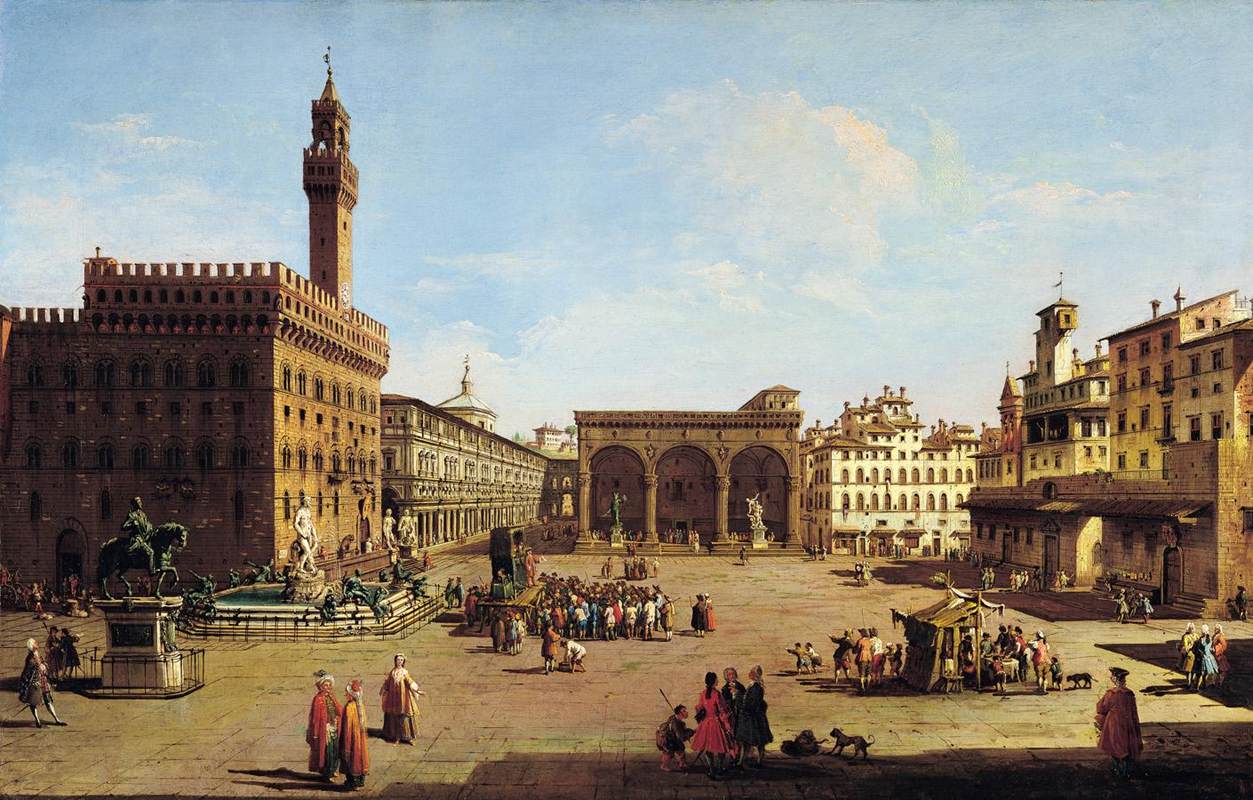
Much of this trading occurred at or near the Mercato Nuovo — the "New Market" — a covered loggia in central Florence that served as the city's commercial hub. Brokers facilitated transactions between buyers and sellers, and prices were common knowledge among the merchant community. When Florence was winning its wars and paying interest on schedule, Monte shares traded near par or at modest discounts. When military setbacks raised doubts about the government's capacity to service its debt, prices dropped sharply.
This secondary market gave Monte shares a liquidity that transformed their economic function. A forced loan that might never be repaid at face value could still be converted into immediate cash by selling the claim to a willing buyer at a discount. Conversely, a speculator who believed the Republic would ultimately honor its obligations could buy distressed Monte shares cheaply and profit handsomely when prices recovered. Anthony Molho's research on surviving transaction records shows that Monte shares circulated actively among Florentine families, forming a significant component of household wealth for the middle and upper classes (Molho, 1971).
The market also created something that Florence's political leaders both needed and feared: a real-time barometer of public confidence in the government. When Monte prices fell, it was a visible, quantifiable signal that the Republic's creditworthiness was deteriorating. This feedback mechanism had no precise precedent. For the first time, a government could observe, in the daily price of its own debt, the market's collective judgment on its fiscal management.
The Monte delle Doti: Renaissance Savings Bonds
In 1425, Florence created an institution that had no parallel anywhere in Europe: the Monte delle Doti, a government-administered dowry fund. Marriage in Renaissance Florence required the bride's family to provide a substantial dowry — a payment that could range from a few hundred florins for a modest family to tens of thousands for the wealthiest houses. Assembling a dowry was one of the most significant financial challenges a Florentine father faced, and the pressure was intense. An inadequate dowry could leave a daughter unmarried, consigned to a convent, or married far below her family's social station.
The Monte delle Doti addressed this problem by allowing fathers to deposit a lump sum with the government when their daughter was young — often just five years old. The deposit earned compound interest over a fixed term of 7, 11, or 15 years, and when the daughter married, the accumulated sum was released as her dowry. If she died before marriage or entered a convent, the terms of repayment varied across different periods, sometimes returning only a portion of the principal (Kirshner and Molho, 1978).
For families, the Monte delle Doti offered a structured savings vehicle that reduced the anxiety of dowry planning. For the Republic, it was a brilliant piece of financial engineering. The fund channeled private savings directly into public debt, providing the government with a reliable source of long-term capital. Deposits were effectively locked up for years, giving the treasury access to patient money that did not demand immediate returns. The fund grew rapidly; within a few decades, it held a significant fraction of the Republic's total outstanding obligations.
The Monte delle Doti was, in essence, the first savings bond. It combined a social function — providing for daughters' futures — with a fiscal function — financing government operations. Modern parallels are numerous: U.S. savings bonds purchased for children's education, government-linked pension schemes, and purpose-specific investment vehicles all descend from the same logic that Florence pioneered six centuries ago.
Medici Power and the Politics of Debt
No account of Florentine public finance can avoid the Medici. From the rise of Cosimo de' Medici in the 1430s through the family's expulsion in 1494 and their eventual return, the Monte system was inseparable from Medici political strategy.
Cosimo understood something that few of his contemporaries grasped with equal clarity: in a republic financed by debt, the largest creditor wielded enormous informal power. The Medici were among the heaviest holders of Monte shares, which meant that the government owed them vast sums and depended on their continued willingness to absorb new debt issuances. Cosimo used this leverage with devastating effectiveness. He cultivated allies by arranging favorable catasto assessments and steering government contracts their way. He crushed opponents by ensuring they received punishing tax evaluations that drained their resources through disproportionate forced loan obligations.
When Cosimo was briefly exiled in 1433 by the rival Albizzi faction, the fiscal consequences were immediate. His departure removed the Republic's most important creditor and financial stabilizer. Monte prices wobbled. Within a year, the Signoria recalled him, recognizing that Florence's fiscal machinery could not function smoothly without Medici capital and Medici cooperation.
Under Cosimo and his grandson Lorenzo the Magnificent, the boundary between private banking and public finance effectively dissolved. The Medici Bank handled government funds, facilitated debt transactions, and served as an intermediary between the Republic and foreign powers. Lorenzo reportedly drew on Monte delle Doti funds for personal use — a practice that, when discovered after his death in 1492, provoked a scandal that contributed to the Medici's temporary downfall. Public money and private fortune had become so intertwined that disentangling them proved nearly impossible.
Art, War, and the Paradox of Public Debt
One of the most striking features of Florentine public finance is the intimate connection between debt and cultural production. The same fiscal system that funded Florence's wars also financed the civic projects that made it the cradle of the Renaissance. Tax revenues that serviced Monte interest payments also supported commissions for public buildings, sculpture, and painting. Wealthy families whose fortunes were partly tied up in Monte shares channeled their remaining wealth into artistic patronage — both for genuine cultural devotion and for the political prestige that patronage conferred.
Cosimo de' Medici spent lavishly on churches, libraries, and artistic commissions, not merely from personal piety but as a deliberate strategy to convert financial capital into social legitimacy. Building the convent of San Marco, endowing the Laurentian Library, and commissioning works from Donatello and Fra Angelico served to burnish the Medici reputation at a time when the family's political dominance depended on maintaining the appearance of civic virtue rather than naked oligarchic control.
War debt and artistic patronage were thus two sides of the same coin — quite literally, the same gold florin. The Republic borrowed to fight, and the interest payments on that borrowing circulated through an economy in which artistic production was a major sector. Florence did not produce great art despite its crushing debt burden. In a perverse but real sense, it produced great art partly because of it.
Florence vs. Venice: Two Republican Models of Sovereign Credit
Florence and Venice developed their public debt systems independently but along parallel lines, and the comparison illuminates fundamental dynamics of sovereign credit that remain relevant today.
Both republics borrowed from their own citizens through forced loans. Both consolidated scattered obligations into unified funded debts — Venice's Monte Vecchio in 1262, Florence's Monte Comune in 1345. Both created secondary markets where government debt traded at fluctuating prices. And both enjoyed a critical advantage over contemporary monarchies: their creditors were also their voters. A king who defaulted on debts owed to foreign bankers might face diplomatic consequences, but a republic that defaulted on debts owed to its own citizens faced political revolution. This alignment of creditor and citizen incentives allowed both Florence and Venice to borrow at rates consistently lower than those available to monarchical governments (Stasavage, 2011).
| Feature | Florence (Monte Comune) | Venice (Monte Vecchio) |
|---|---|---|
| Consolidation date | 1343-1345 | 1262 |
| Standard interest rate | 5% | 5% |
| Assessment method | Estimo / Catasto (1427) | Proportional to assessed wealth |
| Secondary market | Mercato Nuovo | Rialto |
| Dowry fund | Monte delle Doti (1425) | None equivalent |
| Political character | Factional, volatile | Oligarchic, stable |
| Debt at peak (approx.) | ~8 million florins | ~8 million ducats |
| Borrowing cost advantage | Lower than monarchies | Lower than monarchies |
Yet the differences were equally revealing. Venice's oligarchic stability meant that debt policy was managed with relative consistency across centuries. Florence's factional politics meant that debt became a weapon — used by the Medici and their rivals to reward friends and punish enemies. Venice never produced anything equivalent to Florence's Monte delle Doti, perhaps because Venetian society did not face the same dowry inflation pressures, or perhaps because Venice's ruling class preferred to keep public finance strictly separated from social policy.
The Debt Pyramid and Its Collapse
Through the fifteenth century, Florence's debt grew relentlessly. Each new war — against Milan in the 1390s and 1400s, against Lucca in the 1430s, against Naples in the 1470s and 1480s — required fresh rounds of forced lending. The Monte Comune expanded. New Monte funds were created alongside it. Interest obligations consumed an ever-larger share of government revenue, leaving less for investment in the commercial infrastructure that generated the tax base in the first place.
By the 1480s, the Republic was caught in a classic debt spiral. Borrowing to pay interest on existing debt required new debt, which in turn required more interest payments. Lorenzo de' Medici's government resorted to increasingly desperate measures: raiding the Monte delle Doti, manipulating currency values, and deferring interest payments. Monte share prices, which had recovered during periods of peace and prosperity, began a slow decline that reflected growing skepticism about the government's fiscal sustainability.
The crisis came in 1494. King Charles VIII of France invaded Italy, and the Medici regime — weakened by Lorenzo's death in 1492 and his son Piero's incompetent leadership — collapsed almost overnight. Piero de' Medici was expelled, and Florence plunged into a period of political and financial chaos. The Dominican friar Girolamo Savonarola emerged as the dominant political figure, preaching apocalyptic sermons that blamed Florence's troubles on the moral corruption of its ruling class.
Savonarola's republic (1494-1498) attempted fiscal reforms but could not resolve the underlying debt crisis. Monte prices plummeted. Interest payments were suspended or reduced. The Monte delle Doti could not meet its obligations to families expecting dowry payments, creating widespread hardship and fury. Savonarola was eventually arrested, tortured, and executed in 1498, but his downfall did not restore fiscal stability.
The End of the Republic
The final decades of Florentine republicanism were marked by oscillations between Medici restoration and popular government, each transition accompanied by fiscal disruption. The Medici returned in 1512, were expelled again in 1527, and returned definitively in 1530 with the backing of Emperor Charles V's imperial army, which besieged and conquered the city after a prolonged and devastating siege.
In 1532, Alessandro de' Medici was installed as Duke of Florence, ending the Republic and establishing the hereditary Medici principate. The Monte Comune survived the transition — its obligations were too deeply embedded in Florentine society to simply abolish — but its character changed fundamentally. Under the Republic, Monte creditors had been citizens lending to their own government, with at least a theoretical voice in how that government managed its finances. Under the Duchy, and later the Grand Duchy of Tuscany under Cosimo I, they became subjects of a prince, with no more influence over fiscal policy than any other European monarch's creditors.
The Monte system continued to operate into the sixteenth and seventeenth centuries, but the creative tension that had characterized it under the Republic — the interplay between creditor power and citizen governance — was gone. Florence had pioneered something remarkable: a form of public finance in which the people who paid for government were also the people who controlled it. That experiment ended not because it failed financially but because it was overtaken by the broader political transformation of Italy from a patchwork of republics and city-states into territories controlled by dynastic powers.
Legacy: The Architecture of Municipal Credit
Florence's Monte Comune, together with Venice's parallel system, established the fundamental architecture of sovereign credit that persists to this day. Every modern government that issues bonds, pays fixed interest from tax revenues, and watches its debt trade on secondary markets at prices reflecting investor confidence is operating within a framework that Florentine and Venetian officials improvised in the thirteenth, fourteenth, and fifteenth centuries.
Certain innovations were distinctly Florentine. The catasto demonstrated that systematic wealth assessment could serve as the basis for equitable taxation — a principle that underlies every modern income tax. The Monte delle Doti showed that government debt could be structured to serve social objectives, not merely fiscal ones — an insight that resonates in today's social bonds, green bonds, and purpose-linked sovereign instruments. And the Medici's manipulation of the debt system offered an early, cautionary lesson about the political dangers of allowing public finance to become captive to private interests.
Perhaps most importantly, Florence and Venice together demonstrated something that would shape the next five centuries of European history: republics could borrow more cheaply than kings. Where monarchs pledged their personal honor and their kingdoms' revenues to creditors who had no recourse if the crown defaulted, republics offered something more valuable — a system in which the people who bore the cost of debt were the same people who decided whether to incur it. That alignment of incentives, imperfect as it was in practice, gave republican governments a structural advantage in capital markets that helped propel the rise of the Dutch Republic, the financial revolution in England, and ultimately the debt-financed democracies of the modern world.
The Monte Comune was dismantled long ago, but its logic endures in every treasury auction, every municipal bond issuance, every government's anxious monitoring of its credit rating. Florence did not merely borrow money to fight wars and build cathedrals. It invented a way of borrowing that changed what governments could become.
Related
Historical records Learn more about our methodology.